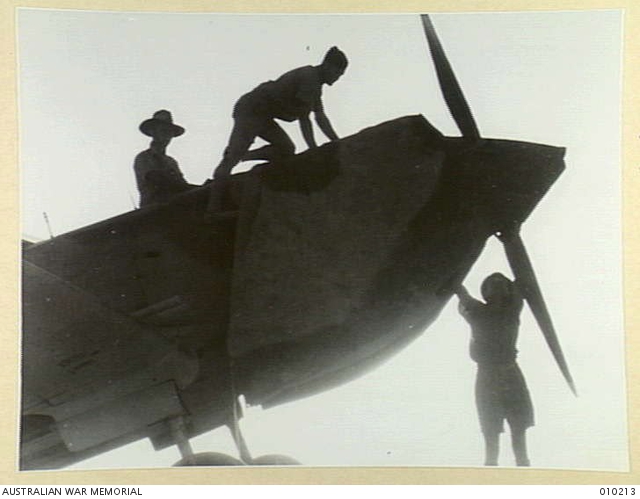
1941-10. WESTERN DESERT. WITH THE AUSTRALIAN FIGHTER SQUADRON.
CREW FITTING COVER OVER "TOMAHAWK" TO KEEP OUT DUST. (NEGATIVE BY G. SILK).
1941-10. WESTERN DESERT. WITH THE AUSTRALIAN FIGHTER
SQUADRON.
CREW FITTING COVER OVER "TOMAHAWK" TO KEEP OUT DUST. (NEGATIVE BY G.
SILK).

Transcript of Australian War
Memorial recording.
This historically-important interview has been placed here so that
its content is searchable for 3SQN Website readers.
[WORKING VERSION
- Currently being edited by 3SQN Assn for readability and spelling
of technical terms.]
INFORMANT: JOHN (JOCK) THOM
SUBJECT OF INTERVIEW: 3 SQUADRON, RAAF
DATE OF INTERVIEW: 4 MAY 1990
INTERVIEWER: EDWARD STOKES
TRANSCRIBER: DIANA NELSON
Identification: This is Edward Stokes recording
with Jock Thom, 3 Squadron, tape one, side one.
Jock, you were born in Scotland, I think.
That's correct.
When and where?
A place called Coatbridge in Lanarckshire. It's
about halfway between Glasgow and Edinburgh on the Glasgow-Edinburgh
road, and railway.
Right. And I understand you did most, well in
fact, all of your schooling in Scotland and had begun an
apprenticeship there, too?
That's correct.
What was it an apprenticeship in?
Automotive engineering.
But I think almost towards the end of that in 1928 the family migrated
to Australia?
That is correct. I had done just on four years in
tech. in Scotland. If you decided on a technical course you
could do a night-school course one year ahead. They are only
starting to realise that sort of thing can be done in Australia at the
moment, but it happened, I can assure you, in 1926, '27.
And the family's move to Australia, was there any
particular reason for that?
Well, my father had the idea, and rightly so as it
turned out, that there were more opportunities for his family here in
Australia than what there was in Great Britain.
Well it was certainly a very different world you came
to. And it was in Australia, I know, that you finished your
apprenticeship and I think by the age of about twenty you were working
at different jobs.
That's correct. I had a job when I came here
first, I had a job to come to because the chap who was the Chief
Engineer of Clyde Engineering at Clyde, next to Granville in New South
Wales was a graduate of engineering from Glasgow University and was
employed by the same company as I was, which was, incidentally, the
Scottish Iron and Steel Company.
Right. Well, that's most interesting.
Perhaps we won't go into more detail of your work before the
war. But just to put on the record I think you were repairing
stations in the back country and later working for a tyre and rubber
company. But amongst all this in the early '30s before the
scheme was phased out, I think you were in the Citizens' Air Force.
For a short time, when I came to this country first,
compulsory training was in vogue and for the first I think it was
about eighteen, well, a little over a year anyhow. You had the
opportunity to get either into the army which for me would have been
the New South Wales Lancers at Parramatta Barracks, or travel to
Richmond and join the air force. And therefore I had a short,
relatively short, sojourn in the air force as a member of the CAF.
And during that period in the CAF were you working as a
fitter, or what were you doing?
Yes, an air frame fitter. I chose air frames
because they didn't want, at that time, engine fitters, they wanted
air frame fitters.
That's interesting. I think, going on a little bit
in the story, it was, pre-war years, I think Christmas '38 you said,
the permanent air force now, was once again advertising for
fitters. You applied, why was that?
Well, you might kid yourself that you were wise in
hindsight, saw a war coming, read all about it, but all these heroics
aside I think there was a small element of that in it but the idea of
playing with aeroplanes and servicing aeroplanes did appeal to me and
that appeal lasted for many years.
(5.00) Right. So just to interpolate on that,
there was a consciousness of war approaching but it wasn't the primary
factor in your enlisting?
No, I don't think in all honesty I could say that it was
the prime factor in the decision I made.
Well, you were saying you did actually join the
permanent air force in, very soon afterwards, February '39 and I think
you went first to Richmond's second of 2 Aircraft Depot. What's
your recollection of that first period in the air force?
Well, it was a new life. It was a life of
challenge because the air force was starting to get aircraft
approaching modern standards and with, at that time, a fairly advanced
for Australian things, technical content in them, and it was most
interesting.
I think you were saying your initial work was on planes
called Walruses and Demons, doing air frame overhauls. How
modern were those planes?
Well, by Australian standards they were our first line,
by world standards they would be fourth or fifth rate in that modern
technology as it was then. Certainly you got all the basics and
all the basic training that was necessary to carry on as happened when
we got more modern aircraft and reached the modern aircraft stage in
the latter stages of the war.
I think you were saying before, Jock, that the training,
or the learning in air frame work and so on that you did was mostly
done on the job, there was no training course as such. Was that
good or bad?
Well, I think it would, looking in hindsight again, I
think it would have been far better to have had a basic training,
technical training in aircraft construction itself, instead of just
learning in the old apprenticeship style from your journeymen and that
was it, because not all journeymen are good journeymen.
Yes, sure, and I suppose there's also a difference
perhaps between a good journeyman in what he can do and what he can
teach.
That's right. Not everybody has got the faculty
for teaching other people; it's a trade apart.
Sure. What about more general recollections of
your very first months in the air force, I suppose the discipline, the
regimentation. Was there much of that? Were you involved
in a lot of parade ground bashing?
I think the air force looked at it more or less in an
advanced light. There wasn't an overabundance of square bashing,
but you had to know your King's Rules and Regulations and you were at
times, especially if you were going for promotion to the higher rank
of corporal, you had to do an oral examination on air force rules and
regulations and procedures. In other ways you got your backside
well kicked if you didn't adhere to the system which you wouldn't have
got the same, probably, supervision in a school, so it had its good
points and it had its bad points. But I would, looking back, I
would prefer that it was a school, the basis to do it.
What about other things of those, that first period in
the air force: recreation, living conditions? What's your
recollection of that?
The living conditions in the air force by and large were
good. The accommodation at Richmond for its time was very
good. We had brick barracks which are still in existence, still
used for the same purpose today at Richmond air base. And I only
had a walk through both the old sergeant's mess, had a look at my old
room in the sergeant's mess, and had a look at my block which was
Block 2 inside the main gate and I was agreeably surprised at the way
they've tarted the accommodation up and made it acceptable for today's
airmen.
(10.00) That's interesting. Well going on a
little bit. I think it was in June 1940 that you were posted to
3 Squadron and it was really only a month later that they went
overseas. That first month in the squadron, what was your
general impression of it, of its organisation of its men?
It was a time of panic reign supreme really, if you want
to coin a stupid phrase for it. Nobody from the CO down knew
precisely what was happening. I even questioned whether Air
Board knew what they were bloody well doing either.
Do you mean in terms of where the squadron was to go or
how it was to get there?
In all phases. This was something new. I
don't think really that we were completely prepared for the
eventuality of war.
I guess, am I correct in saying that 3 Squadron was the
first fully equipped Australian squadron ever to go overseas?
That certainly is correct. 10 Squadron left
Richmond Air Base before Christmas 1939 but it went over in dribs and
drabs. There were some people over there taking control of
Sunderland aircraft then it was decided to put a whole squadron over
there and everybody that missed out on a posting to 10 Squadron felt
that the world had come to a bloody end.
In that very frenetic month, Jock, were you very
involved in the physical preparations of leaving? And if you
were, what were you doing?
Mostly we were getting injections, getting our field
gear up to scratch and having a few gargles down at Ma Tunnels which
is the pub at Clarendon station, affectionately known as 'Ma's'.
Soaking up some good Australian life before it was all
over. So it sounds as if that month was very much a month of, in
a sense, more personal organisation rather than major logistical
organisation of the squadron.
Oh yes, that would be a fair comment, I would think
generally speaking. Yes, I agree with you.
Just one thing perhaps to dwell upon for the moment,
Jock, you were saying, mentioning some of the names involved in the
squadron in Sydney. We had the officer in charge of air frames,
Larry Adler, his Warrant Officer, one. Ted Stocker, IC Air Frame, Wing
Commander Seachamp, Station Engineering Officer, his offsider, Warrant
Officer, one, Hagfath, IC Engineering Air Section. How
closely did warrant officers and their officers work together on the
maintenance side of the squadron?
A warrant officer usually got there from years of
training, had been through all the mill himself and generally speaking
the peacetime air force warrant officers were both knowledgeable and
approachable.
That's interesting. Are you suggesting that they were
different to the wartime warrant officers?
Well, yes, inasmuch that they didn't get their promotion
quickly. They got their promotion not by the effluxion of time
but a combination of exams, periodical exams. They'd come
through the ranks, had heard all the hard luck stories, knew when a
bludger was a bludger, and generally speaking these men were, as I
said first, knowledgeable and experienced, and if asked properly would
go to great lengths to tell you the proper way to do it.
And I understand those points about the wartime
men. What about the officers? Do you think there were
differences either in attitude, character, approach to the service,
between permanent officers and wartime officers?
(15.00) It's hard to make a general statement on
that. Like all walks of life there are good and bad. Some
of the finest persons I've met even to today were permanent air force
officers. My choice of permanent air force officers of great
significant value would be that of Group Captain Peter Jeffrey, the
second CO of 3 Squadron, and the CO of Richmond aerodrome when I first
got back from the Middle East was then Air Marshal - afterwards he was
Air Marshall - Sir Frederick Scherger. Both led from in front,
were approachable, knowledgeable and very, very good disciplinarians.
That's interesting. We might actually come back to
talk about Peter Jeffrey in the context of some of the other squadron
leaders later, Jock. Well, let's move on a little bit. The
decision came that the squadron was to go overseas although, of
course, you didn't officially know where although I'm sure there were
strong rumours. What were your feelings on, well, just before
embarkation and, incidentally, how did your family feel about your
going overseas?
My mother had recently died. My father had two
sisters to look after him when I was gone. I more or less think
that I treated it as a great adventure.
Well, could I just clarify that it's something that
people often refer to? Were you primarily going overseas in a
patriotic sense to fight for your country or was it more a personal
thing of seeking a kind of personal adventure?
Well, part of both. There would be nobody, I
think, more patriotic to this country and to Britain than I am.
Always have been, and that, I must agree, would be part of my reaction
of going off to war. I was old enough to realise the seriousness
of it and that it was not going to be a piece of cake, and it wasn't.
I might just pick up on something you said there?
You were, of course, quite a lot older than a good deal, or probably
the majority of the men in the squadron, although in fact not so old
yourself. Right. We've just worked out that Jock was
twenty-seven when they went overseas. How did that affect your
relationships with other men within the squadron? Did they look
up to you as a kind of father figure, or not?
No. You were judged on your own merits.
There can be no harder taskmaster than being tried by your peers, and
that, I think, is applicable today as it was then.
But in terms of day to day living, did men who might
only have been nineteen and twenty, slightly turn to, or rather, turn
to men who were slightly older or not?
Oh yes, the very young that were there, and I'm talking
about the eighteen, nineteen year olds. Some of them were very,
very young, eighteen and nineteen year olders. Some were very
old nineteen year olders. It depended on what strata of society
that they came from, and their areas of affluence, but war is a great
leveller I've found, and it didn't take long for people to sort
themselves out.
Well, let's go back to the voyage. It was on the Orontes
which was then, of course, still equipped and, I mean in its peacetime
fittings and so on. On her to Bombay and then the Dilwara
from there on. What's your recollection of the journey on the Orontes?
The journey on the Orontes was, looking back on
it, was the best trip the government had provided me with. I had
been on ocean liners. I came here on the Ormond and the
Orient boats, this was a newer vessel, better appointed, and we were
treated as passengers.
Did you do any training while you were on the voyage to
the Middle East, or not?
Actual training, no. We did physical exercises and
that, more to keep fit than anything else. And to cut down on
boredom because there were no dancing girls provided which was most
unfortunate.
That was a bit of an oversight on the part of the
authorities.
Oh yes.
Well, I imagine if there weren't any dancing girls on the
Orontes there were even fewer on the Dilwara.
The Dilwara was a disaster. We were conned
by the 'Poms' in a big way. We were docked ahead of the Dilwara
which was a small transport, was a permanent British army transport
designed to take no more than 600 people, officers and men from one
foreign posting to the other. We were given the forward hold and
the forward mess deck as our portion of the ship. On the mess
deck you slept under the table, on the tables, or slung a hammock from
pipes above the table. So we had a three-deck bedding layer and
there was only one .... The hatches on the deck were the only
ventilators. All portholes were closed. There were no fans
and to say the least of it, it was quite warm.
Sounds like a hell hole, Jock. And what about the
food?
The food was atrocious. They had stocked up in
India, mainly with a form of Indian fish which had a very pungent
odour and a worse taste. Apart from that the ovens and the
stoves on the ship were a disgrace.
Well, let me just turn to a slightly different issue in
all this. Were the officers on the Dilwara much better
set up than the men, or not?
Oh yes, the average British outfit looks after its
officers to a much greater extent than they looked after their troops.
Were men very, well, conscious or resentful of this
general set-up on the deck of the Dilwara?
Which Australian wouldn't be? I'll give you an
example. We rebelled about staying down in the hold in crossing
the Red Sea. The officers had deck chairs on the officers' deck
which other ranks were never allowed to tread. So we decided
that that's where we were going to sleep. So we went up and next
thing we knew the military police and the OC Troops ....
Were there English troops on the ship too, or
only ....
Yes.
So the military police, were they British or Australian?
British. Ah. The OC of the troopship was a
colonel. Colonel Blimp was a good indication of what he looked
like. And his intelligence quota would about on a par with what
the Colonel Blimp of film fame portrayed.
So
once you moved up onto the deck what happened?
Well, we were ordered to remove ourselves back down to
the cattle-truck underneath. So the following evening the
officers had no deck chairs to sleep on. Somebody said that they
saw them disappearing over the side. And that wasn't viewed by
the OC Troops with any great favour I can tell you.
Let's just be clear on this. In a roundabout way,
are you saying that the chairs were actually thrown over, or were they
secreted somewhere else on the ship?
I never saw them thrown over. But as they searched
the ship for 'em and they weren't on the ship, there's only one place
they could have gone.
I
suppose the seagulls might have picked them up?
I never thought on that one before, but then again, I'm not a very
facetious person.
So, seriously now though, what actually happened?
I mean was that something that the British commanding officer just had
to grin and bear or were there great ructions?
Oh well, there was threats as there always is threats
and life has taught me that it's a useless thing, threatening.
Don't indulge in it. Won't stand for it.
So
it was a stand-off, was it?
(25.00) Oh, it was a stand-off. He got our back up and the
nameplate which was on every ship was screwed to the front of the
bridge, or bolted, I can't remember which, but the day before we got
into Port Tewfik that nameplate disappeared, and the poor
captain of the ship and the OC [inaudible] did everything in a most
appealing manner from the bridge that this had to be returned.
And if it wasn't returned all dire threats were that we would be
thrown in the citadel, the military prison, in Cairo.
An appeal from our own officers brought some results, I don't know why
but it suddenly appeared down in front of the purser's office and I
think, the military guard that was waiting for us at Port Tewfik were
dispersed and sent back to their barracks because we
arrived without any how-do'ye-do.
We'd better not dwell on this too long because there are
probably more important things to go on to, but just briefly, what was
the role of the Australian officers in all of this?
Our own officers had to abide by the rules. We
were quite well aware of this but I think secretly they agreed that
the conditions that we were forced to be in and that, was, well it
wasn't what it should have been. But then, we were new to this
game then. We hadn't lived rough before but we soon learnt.
Well going on a little bit, Jock, just in general terms,
arriving in the Middle East: a very different part of the world
to Australia in terms of its life. What was your reaction to
it? What was the reaction of most men?
I think most people viewed it in the light that it was
new. And going up in the railway up to Ismailia which was the
first station we were posted to, we passed these canals, irrigation
canals, which came from the Nile and in that they used as their
drinking water, their bathroom and their toilet. And I think
that horrified me more than anything else.
But did you get much time when you were over there, this
is looking at the whole period in the Middle East, much leave, odd
days here and there to get around and see the sights? And did
men try to do that or were they so caught up in their own life that it
was more a matter of just, you know, washing of socks and shirt and
flopping on a bed in camp?
Oh no, I think everybody, I was I know, keen to see
whatever sights were available and to see as much as I could of a
foreign country while it lasted because we all realised that what we
were about now was the good times, that the bad times wouldn't be that
long in coming.
Sure. Well let's move on a little bit. As
you were saying the squadron did go first to Ismailia where you were
allocated a number of Gauntlets. Was there ever any feeling in
the squadron that the British squadrons were getting the better
planes, such as Hurricanes and the Australians weren't? Was that
just accepted as the fact that planes were in short supply, or was
there some resentment towards the British for giving Australians much
older planes?
No, I don't think that really was basically the reaction
from chaps such as myself. I viewed it in this light, obviously
they were short of supplies, and by them I mean the RAF were short of
supplies, like ourselves. There was no evidence that they had
overabundance of military equipment. In fact it was very obvious
that we were an army co-operation squadron and we had no army
co-operation aeroplanes to operate. But a convoy got through
Malta, Gibraltar and Malta and we were told that we had allocation of
some Lysander aircraft but we'd have to assemble them ourselves.
END OF TAPE 1, SIDE A
BEGIN TAPE 1, SIDE B
Identification: This is Ed Stokes with Jock Thom,
3 Squadron, side two of tape one.
Well, I was going to go on actually to ask about assembling the
Lysanders, Jock. I know you went to Aba Aswear, that's
incidentally A-B-A A-S-W-E-A-R, to assemble some of these Lysanders
you'd been given, I think, three. How on earth do you assemble a
plane that you've never seen before?
Ah, there were a few odd permanent RAF staff like flight
sergeants and WOs who were very knowledgeable people. And if you
asked properly, you were told. And if they didn't know they'd
find you a manual.
And
manuals, were they ...?
They were not in plentiful supply by any means but there were a few
manuals floating around.
The manuals. Were they specific down to the
smallest part of the aeroplane, the smallest screw and so on or only
general?
Oh no, they were a pretty good manual. The
Lysander manual was a pretty detailed manual and if you happened to be
a tradesman, and not all of us were tradesmen, but if you happened to
be a tradesman and had tradesman's training, it wasn't an
insurmountable job to follow your manual.
How long would it take? I don't know who many men
would be working on a job, but how ever many were, perhaps you could
tell us that? How long would it take to put a plane together?
Well, that's the first time I've been asked that
question and quite frankly I wouldn't like to put a timescale on
it. Ah, but I'll make this comment. We worked long hours
where the RAF were, and most people there were permanent RAF, took off
from .... They started at seven o'clock in the morning, they'd
work till twelve and then they'd have two hours rest in the hot day
because it does get hot over there in the Canal zone. And then
they'd start and they'd work till five. We just kept working.
Do you think that was partly that Australians found it
easier coping with the heat?
Could be, because at that time I had been ten years in
Australia more or less and um, I had become more an Australian than a
Scot.
Well let's move on a little bit, Jock. After this
period with putting the Lysanders together I know the squadron
regrouped at Helwan where you by now had Gauntlets, Gladiators,
Lysanders and I think a Gloucester biplane. Having a number of
different aircraft such as those in one squadron, what problems did
that create for ground crew such as yourself?
(5.00) Oh well, we had a title for that sort of
thing and it's called 'Snafu', 'Situation Normal All Messed Up', work
it out for yourself.
Right. So things were really at sixes and sevens?
Oh yes, it was an unstabilising or destabilising
arrangement, especially as all the equipment was old, out of date, and
it wasn't a great morale booster that we'd .... But we, I think,
accepted the fact that we'd have to make do with what we had been
given. There was no alternative.
Spare parts, were they in reasonable supply? Or
were they as rare as hens' teeth?
Well, hens had a full set of dentures - would be a
comment, I suppose, facetious but still that gives you some idea of
the availability of spare parts.
So was there a lot, I know there was a lot of scavenging
of other things later, but in terms of aircraft parts specifically,
could you scavenge? Or was there nothing to scavenge from?
You got the wrong title for it. Scavenge or steal
doesn't come into it. There was a magical word for it and it was
called scrounge. What we didn't have, we pinched.
First
come, best dressed.
Oh yes. If we didn't have it and other people had
it, especially enemy gear, we lived on that and we had I think quite a
deserved reputation in the military forces in the Middle East that we
were called the 'Hydraulic Squadron', lift anything.
I know later, Jock, you were working, doing maintenance
and so on in very primitive conditions on desert airstrips, but this
early work at places such as Ismailia, Abu Sueir, Helwan, what were
your working facilities like? I mean were you in covered hangars
or what?
Oh yes, the, especially Abu Sueir and Aboukir which were
the two main depots in the Canal zone, they were well equipped except
with the vital goods which was modern aircraft. They didn't have
any of those. But as far as gear and hangars and that, yes,
their gear was good, their equipment non-existent.
By
equipment you mean spare parts?
Spare parts, lifting equipment. The hangars were there, they had
concrete floors and they had space and they had runways and they had
tarmacs in front of the hangars and all that was there. But no
aircraft, was the cry. No transport. We
went into the desert, I think, the poorest transport facilities, then
we came out of it with the best transport in the Middle East.
Mm,
yes, well ...
Enemy goods was fair game.
Of course. We'll come onto that later. Well
let's go on now to what was a very particular episode. You were
detached with a number of other men from Helwan to RAF Squadron 208,
at a place called, Qasaba, I think.
Yes.
Q-U-A-S-A-B-A [sic]. And just for the record this was
20 September '40 to late October '40, 1940.
The officers were Flight Lieutenant Blake Pelly in charge, Flight
Lieutenant Rawlinson, Flight Lieutenant Peter Turnbull, Flying Officer
Lindsay Knowles plus twelve airmen and a few others who followed on
later. Those names, incidentally, from Jock's record of 3
Squadron activities. What was the point of this detachment?
Well, theoretically, officers and men had been trained
in the theory of war. This was to give some working knowledge of
actions in war. Doing a 200 hourly inspection on a aircraft such
as a Gauntlet or a, or any aircraft for that matter, out in the sand
and the sand blowing all around you is different, totally different,
than doing it in a hangar, or on a tarmac. So procedures were
different, attitudes had, of necessity, to be different, and this was
the best training we could get, and 208 Squadron personnel, officers
and men, treated us very well; nothing was a trouble to them.
They didn't have very much either.
(10.00) And we might actually come to talk about
the specifics of open air maintenance just in a short while when we're
actually out in the desert ourselves, so to speak. But I think
one of the other points of this contact was for the pilots to improve
their army co-operation work, is that correct?
Yes, that was the, what we left Australia to be; an army
co-operation unit, particularly for operations with the 6th Division
AIF. The old-fashioned idea of what army co-operation was, was
soon dispelled. It was a different war and a different era with
different things, under totally different circumstances. A
Lysander floating around in the air at sixty knots with flaps down
spotting for artillery, that had gone out with straw boaters.
So it was a much faster sort of war and that kind of
leisurely reconnaissance just wasn't on.
No.
I think, though, and of course that lesson hadn't, perhaps, quite been
totally absorbed and so there was this, still some training in army
co-operation. I understand you, besides being an air frame man,
were also trained as an observation and air gunner?
That was something that we did when we were in the
CAF. Ah, it was part and parcel of what they did in the
permanent air force prior to 1939.
Did that training continue now with 208 Squadron, or
were you only doing ground maintenance training?
Only doing ground maintenance, under battle conditions.
Well, would you like to recall any more of that first
battle condition ground maintenance training, Jock?
Well, it's hard to find something, describe something
that is poles apart. Cleanliness, lack of dust, scrupulous
cleanliness really, was instilled into you in peacetime in
Australia. How do you cope with that, trying to get that sort of
thing in the middle of a dust storm, when a dust storm blows, not for
an hour, but sometimes for two or three days, night and day? Er,
totally different war. Totally different set of circumstances.
Let's again, if you don't mind, just leave the specifics
about that - I think are terribly important - 'cause they somehow fit
in a moment later. I think it was late 19, oh sorry, late
October 1940 when the men who'd been detached, or most of them, joined
the squadron at Gerawla where the squadron built a camp
and it was really here that you began changing to a more
direct fighter support role than an army support operation?
That is correct.
And some men here who therefore became redundant were posted to RAF
squadrons. Extra Gauntlets arrived. What's your recollection
of that period before you got involved in the actual fighting?
Well, it was an experience of learning. Learning to
operate under these not too pleasant conditions. Knowing full
well that it was going to last for a long time you had to find a
solution to it and bring your mental approach to it. In other
words, stop grizzling and get on with the job.
Was there much apprehension about not only the physical
hardships and difficulties but the sheer outright danger of being
strafed or bombed or injured or killed in some way. Did men
think about that much, talk about it?
I would think there'd be very few men that didn't think
about it. But thinking about it and dwelling on it is two
different things. Let's say that part of the process of learning
there was to learn to live with it. Some great philosopher in
the ages said, 'Sufficient unto the day thereof', 'Sufficient unto the
day is the evil thereof for tomorrow never comes', Omar.
(15.00) Was that sort of day to day mentality what
really kept you going?
Well, it was part of the thought process I
suppose. The squadron was starting to find its own
identity. The same as the men were finding their own identity
and the niche that they had to operate in in that particular
circumstances. I don't think there was any heroics attached to
it at all. It was a case of if you didn't learn and you didn't
beat it, it would beat you, and the realisation that that was the bare
facts of life made you try harder.
The first death in the squadron, 19th of November, we've
worked out. Squadron Leader Heath's, second-in-charge of the
squadron, he didn't come back; first killed in action. How did
that affect the squadron?
Well, it was the first signal that this wasn't games we
were playing. I think, concisely, that could be said to be the
lesson that was learnt from Peter Heath's demise. The gloves
were off and we were into it then.
That's very clearly put, Jock. Let's go on now to
talk about what is in a way central to your war, what you did with the
squadron in the Middle East. And that is, the techniques as
you've put it of open air, primitive condition frontline servicing;
that seems to put it very well. But let's talk about it in some
detail. What was the single greatest difficulty?
The single greatest difficulty wasn't getting the
aircraft into a rigging position, that was meant as the true flying
position, but in the lifting of heavy engines when you had to do an
engine change. And engine change is, even with the best of
equipment, is an awkward job, and a delicate job. You can do an
awful lot of damage wrestling around with a flopping great heavy motor
hanging on the end of a chain.
It made it very hard but it made the boys depend on one another.
The man that was looking after to see if the engine bolts were in the
right position, he knew he had to be right, the same with the man who
was pulling on the block and tackle, raising or lowering
it, pushing and shoving it, as we used to call it. But you work
out, a technique was worked out where we could change a motor in a
pretty good time, even under those conditions and do it well.
How
long would it take for an average engine change?
Well, depends on the aircraft. It varies from aircraft to
aircraft, but in a ....
Say,
a Kittyhawk?
Oh, a Kittyhawk, an in-line motor, oh, I've seen it done in a
day. I've seen one on a Gladiator done in five hours, but
that's a radial motor and it's a frontal attack upon it. It's
not sitting like an in-line motor is sitting on a cradle. An
in-line motor's much harder to do than the, er, the radial motor.
That's very, very interesting, Jock. Some other
things about the work you did. I've already asked about how rare
spare parts and so on were. How much did you innovate? How
much did you actually manufacture parts on the job?
(20.00) Well, to answer that sensibly I'd have to
leap-frog a bit till after the fall of Tobruk. When Tobruk fell,
our engineering officer, Bert Boddison and a little, cheeky LAC we had
called Billy Lee, whose father and brother I worked for in a garage at
Parramatta about 19, for a short period about 1929, was an excellent
fitter and turner. Had served his time at Howard Auto
Cultivators, I think, from memory in North Parramatta.
We got this Italian workshop tender and it was the greatest scrounging
prize we ever had because it had a lathe, it had a vertical drill, it
had all the spanners that were necessary, it even had very high carbon
steels in various forms, and many a spare part for motor
transport and many an attachment for aircraft was manufactured by
Billy Lee in that workshop. And that was I believe, when I left
the squadron it was still our prize possession. I believe they
dragged it all the way to Sidi Azeiz. I don't know whether it
went to Sicily in Italy, but if it didn't, they threw away a prize
piece of equipment.
That's very interesting, Jock. You were explaining
before how engines were lifted by basically building a kind of a metal
tripod. And I'd asked why planes weren't themselves dug down
into the ground to lower the actual body of the plane. I thought
that was quite interesting the reason why not.
Well, the reason why not, was very simple if you'd been
there. The person's concept of what the desert was, was you
know, Lawrence of Arabia in the movies, where they'd charge
over sandhills and down great sand dunes. That's not what the
bloody desert was like. It was hard, rock hard shale, and dust,
powder dust. Very much like, in parts, the Nullarbor Plains
[sic] prior to the main road going through there; dreadful country.
Well, I've been out that way, I know what it's like,
hard as hell and certainly you don't want to dig holes in it.
You mentioned dust. How great a problem was dust with engines,
both in terms of dust getting into the engines when they were actually
running, taking off and all the dust being kicked up, not to mention
dust storms, and also the somewhat different problem of keeping dust
out of engines when you were trying to fix them up?
Well, it was a problem. How we got away with some
of the things that we did, it was against all principles of
engineering. It was a horror really. One could say that a
Curtiss electric clock is a very fine piece of engineering, and it is,
small gears in the hub where all the blades are controlled by these
small gears, grease being necessary to keep them lubricated.
Grease in the dust storm was just like flies on flypaper. How it
didn't, it lessened the useful life of both engines and engines' ancillary pieces to a great degree, but how we didn't have more
failures in some of the things that we did and some of the parts that
we scrounged and built up ....
Correct me if I'm wrong, Jock, but I would assume that a
bit of dust in the fuel lines of a plane could be disastrous. I
mean, a bit of dust in the fuel line of a car and you've got a
stuttering engine. Is that correct, or not?
It's just as applicable to an aeroplane as it is to a
motorcar.
How
did you keep the fuel lines clean?
Well, you had a rag round the end of it, and you didn't
connect the fuel lines at all, you never left them open. You
tied a lump of rag or stuffed a bit of waste of something in it.
Then you had to make doubly certain that you didn't leave any in
there. That was one of the great problems. But as I say,
how we didn't have more failures, I wouldn't know, but you must
realise that an engine didn't last long in desert conditions.
(25.00) How many hours?
Depend how many big dust storms you had and how many times you had
to push it through the gate.
Let's
say on average.
Oh, I've seen them going back stuffed at 150, 200 hours; as low as
that.
Well look, just two final questions on this issue.
I'm sure it will crop up in different ways as we go on. What
were the hours that you often had to work and did you work at night to
get planes serviceable for flights the next morning?
Well, sometimes it was possible to work at night under a
tarp, but if you put a light on you drew the crabs. And as
mostly the boys were camped down fairly close to the service areas,
you only worked at night if it was absolutely, an absolute
necessity. I think the hairiest thing that happened to me at
all, and when I was more frightened than any other time in the air
force, was Gordon Steege came in one night from a dusk patrol in a
Gladiator and blew a tyre when he came in. But that aircraft, we
were running short of aircraft, and that aircraft had to, just had to
get up the next morning. So we had to go out in the dark and
jack it up and change a wheel. Of course we didn't change a
tyre, we just robbed another unserviceable aircraft and changed a
wheel.
But in that time we were right out in the middle of the 'drome, with a
light on. And the old Savoias used to come over at night and they
all had daisy, what they call daisy cutters, anti-personnel bombs, and
they fractured into pieces about, oh, a pound weight of
metal, probably about, anything up to about three-eighths of an inch
thick with jagged edges and it used to make a horrible mess of planes
and people. And the thought of that, I don't care how blasé
people get, if they weren't frightened and they had to do that at
night with a light, there was something mentally wrong with
them. It was not a good job, but if it had to be done, it just
had to be done. It wasn't done often I can tell you that because
nobody wanted lights.
Just a final question, Jock, how much did personal
qualities matter in all this, besides of course the obvious technical
competence of people?
Well, people could be technically very competent and yet
be not compatible, one to the other. The human relations
problem, if it had to be a problem, was determined on a one to one
basis. In other words, if you felt happy with a man as an
offsider, and you were working on a technical problem, and the other
man you couldn't stand the sight of, well, you didn't get on with him
at all, and he was technically excellent, of course you would choose
the man who was just fairly competent.
That's
interesting.
These sort of things were worked out all the time.
Just
informally, man to man?
Man to man. It was purely a man to man basis.
One other thing related to that is, were ground crews
generally responsible for a particular plane or a particular couple of
planes?
In the main, yes. A pilot had his crew and which,
if he wanted to live long and he wanted to make life a lot easier for
himself he got to know his crew; he became part of the crew.
Yes, I was going to follow on and in fact ask you just
that. By and large, I'm looking at the broad spectrum of pilots,
did most of them, all of them, or only some of them have that
relationship with their crew?
Like all human attitudes, in some men it is different
than in others, but we were very fortunate that we had one Peter
Jeffrey who almost made it mandatory with new arrivals, new pilot
arrivals that ....
END TAPE 1, SIDE B
BEGIN TAPE 2, SIDE A
Identification: Edward Stokes with Jock Thom, 3
Squadron, tape two, side one.
You were saying about Peter Jeffrey and the ground crew.
Well, I'll repeat the thing. We were fortunate for
the greatest part of my time there in 3 Squadron having one, Peter
Jeffrey, who almost made it mandatory that new arrival pilots must
meet and fraternise with their ground crew. This created a great
feeling of companionship in the squadron. And my own opinion is
that that's why the 3 Squadron operated with such efficiency.
There was a personal liaison between ground crew and air crew.
That personal liaison, did it extend beyond the
camaraderie of men, pilots, returning and chatting with the ground
crew and that sort of thing? Did it extend to going off on
excursions, on leave together, that kind of thing as for instance
bomber command crews definitely did? Or was it, can you see the
distinction I'm trying to get at?
Well, put it this way. Usually officers moved in a
circle by reason of the traditions of the British Army, or the British
military forces; that officers and men, and other ranks, did not mix
very much. But if some of our chappies got into strife on leave
and there was an officer in the vicinity, the first place we made for
was to inform the officer. And I know of no circumstances where
that officer did not make a beeline straight to the area of the
disturbance, and try his damndest to get 3 Squadron blokes out of
trouble.
I was going to ask later Jock, but perhaps now's the
moment. The commanding officers of the squadron, Squadron
Leaders McLachlan, Peter Jeffrey and Gibbes, just to take those
three. How did they differ? Which was the best?
Well, you look back on the family circle. It would
be a rarity if you found all brothers in the one family of a like
disposition, and the same with COs of units. Some people, or
some persons, fall into a category where they are born leaders.
Who was the born leader in that group? And who
wasn't?
No, I wouldn't say that you would say any of them wasn't
a born leader. A leader of what? In aircraft combat, we
had many and it's well recorded that we had many ace pilots who proved
by their deeds that they were men of valour. The rarity occurred
when you had a man that could excel in that, he could also excel in
leading the squadron in other ways; they are not common, never are,
never were. But to fall into a trap, let's call it, of saying
that one man was better than the other; one man would be better than
the other man in some things. The man that stood out was the man
that was good at all of 'em, and that's the born leader.
(5.00) And I think you suggested before, at any
rate, that Peter Jeffrey was that man?
Peter Jeffrey in my opinion made 3 Squadron with the
help of his other officers. Various other officers didn't rise
in my view, and this is a personal view, to the heights that Jeffrey
did for the simple reason: their natures were different.
Jeffrey had an insight into getting the best possible effort out of
anybody he had that came under his command and I will always, not be
grateful, I will always honour the man for it. He's a man of
exceptional ability. He's a man of exceptional forbearance, but
he wasn't an easy one if you got on the wrong side of him.
That's most interesting, Jock, especially that
distinction which I'm sure is true between the different, you know,
people being brilliant in their different ways and so on. Just to move
on now to some other things. December to January '40 the
squadron was travelling on towards Tobruk using forward aerodromes
vacated by the Italians until you reached Bardia, I think. There
was a great cache of equipment along the route as the Italians were
swept back: planes, spare equipment, trucks, et cetera.
How did that affect your life?
Well, it affected us to the extent that we had equipment
both in motor transport, especially in motor transport I would
say. And being a mobile squadron that was all important.
The squadron could not function unless it had adequate available
transport because if the enemy ran you had to catch up with him pretty
quick. And if he broke through as Jerry did, when Rommel
appeared on the scene, we had to run very quick. You can't do
that on foot, not in the desert.
Yes, that's interesting. One of the places, of
course, you travelled to and where transport no doubt was critical was
your journey down to Giarabub. I just thought I'd ask you about
this, simply because this journey, which I think was to restore a
plane with a wrecked undercarriage, perhaps typified the kind of life
you led. How did that begin? And how did the journey turn
out?
Well, that was actually one that happened just at the
start and before the start it was, slightly before the start of the
Italian campaign or the attack on Sidi Barrani. Giarabub was a
fort out from Siwa oasis. The Bren gun section of the 6th Divy
was out there and it was an army co-operation exercise that was going
on with these very light tanks. When the Gladiator crashed and
buckled his undercart, at that time war hadn't really hit us, it
became an exciting adventure rather than an episode of war. But
we treated things like that a bit more seriously later on when there
was sometimes a lot of danger of getting off the beaten track.
You'd get a roving patrol get on you and you were gone.
(10.00) So on this particular occasion getting down
there was relatively straightforward. Fixing an undercart, an
undercarriage, out in the middle of nowhere, how easy or hard was
that?
Well, things like that were never easy. There was
a lot of hard, back breaking work attached to it. But then, we
were all young and strong, ambitious, motivated, and that didn't seem
to worry us at all.
That's interesting. Well let's move on a little
bit. During the advance after that period, Sidi Barrani, Solum,
Hellfire Pass, these were some of the places we went through a while
ago, east of Tobruk and then Gambut [sic] just east of Tobruk.
Gambut.
Gambut, just east of Tobruk and then Gazala, G-A-Z-A-L-A, west of
Tobruk. During that period the squadron was converting to
Hurricanes. What's your recollection of that period? And how
much extra stress did it put on the ground staff?
It put stress on everybody. The pilots had learned
techniques, and I'm talking as an observer, not as a pilot, and
probably I'm talking out of turn. I would think that the type of
flying a single-engined monoplane, low wing one-plane would be
completely different than a biplane.
Going back to this issue of the conversion to the
Hurricanes, Jock. How did it affect the ground staff such as
yourself?
The aircraft in itself was completely different. The component
parts and style of servicing required was totally
different. The only good thing about it is, we who had worked on
Demons, had experience in the Rolls Royce Kestrel motor a much
under-powered motor compared with that that we found ourselves with in
the Hurricane. But basically the training stood us in good
stead. Hydraulics are hydraulics. Cables are cables.
If you use your brains you can overcome these small problems.
But they were a sturdy aircraft. They were an easily serviced
aircraft. The only bad thing about 'em was they came down and
you had no battery cart, you did not start it again. And that
was, as far as desert warfare was concerned, was a highly undesirable
feature of the aircraft.
Do you mean in that it was impossible for a pilot to
land away from base and start the plane?
Start his motor and then take off again. You could
not start it without a battery cart.
I see, whereas planes such as the Kittyhawk, for
example, you could.
Yep.
Why did they design a plane in that way?
Well, who would know that? Only Hawker Aircraft,
and the Air Ministry England would know that. It certainly
wasn't designed for anything other than close field operation where
you had many aerodromes within a very short period.
In other words the sort of Battle of Britain situation
where if you didn't make it home to base you went to somebody else's.
That's right, somebody else's. But that wasn't
good enough for the desert but they were a good aircraft. They
were a good aircraft to work on, and they were a serviceable aircraft,
they were a sturdy aircraft.
Right. Just one other thing to do with ground work
but not particularly Hurricanes. Refuelling planes, I assume
that was done by the ground staff. How was that done? Was
that pumped in manually, or how?
(15.00) Well at various stages it was the most
primitive operation I've ever come across. When we started off
first with 208 Squadron petrol supplies came crated in two
four-gallon tins to the crate, in a wooden crate. These were
poured in, in the main plane, with a funnel. And if you can get
anything more crude than that, well, you'd have to get a hold of
Wackett's Widgeon or some prehistoric monster like that.
No. Then we had pumps and pumped them out of forty-four gallon
drums when we got really in the big time.
Then we had a couple of fuel tenders which we had to
fill the fuel tender from forty-four gallon drums. And by the
time you got onto a pump handle and move it up and down a few times,
your arm gets bloody tired. So we built a rack and a pipeline
and we put a battery of half a dozen forty-four gallon drums in a row
up on their side, get the hoses into the main thing and then pump
that, or let it flow, gravity feed it into a, I think it was 2000
gallons was the biggest petrol tanker we ever had. And that
doesn't go far if you're servicing twenty-five aircraft.
Mm, I'm sure. One other thing that I in fact meant
to ask you before but forgot. How much was heat a problem, not
only the heat that obviously could be quite enervating in the desert
but the sheer heat of metal in terms of working with metal, for
example, the fuselage of a plane during the day?
Well, it was a funny place. I've seen it at four
o'clock in the morning with every stitch of clothing that you could
carry on you and a couple of blankets, your teeth were
chattering. Yet, at twelve o'clock after refuelling an aircraft,
sliding down the main plane with just a pair of shorts on, it would
burn your backside off. So you had great extremes in short
periods of time. But with the food that we had, the rigorous
conditions that we lived in, I must say, I came out of the desert
after seven months in one spell, hadn't been east of Mersa Matruh, I
was as thin as a rake and as fit as a fiddle. And I could run
all day. Queer place but the human frame adapts.
I'm sure apart from the extreme heat that kind of desert
environment in fact generally is a fairly healthy one.
Well, it's dry. How the old gut put up with all
that dust, damned if I know.
What about all that food? How did you put up with
that?
Well, the food was adequate to keep you alive,
monotonous. I was with, when I went to Giarabub, we were fed,
the 6th Punjabis were there and also, of course, the Bren gun carriers
from the 6th Divy. Ah, but we were issued with Indian Army
rations, with no meat, ah ....
Was
it good food?
Yeah, but tasteless. Oh, horribly monotonous, but you were
healthy with it. And those dog biscuits that everybody claims
about, they break your jaw and certainly your false teeth. You
never die eating them.
Mm. Right, so it was spartan fare.
Oh yes.
But it was quite good to get through on. Well, let's move on with
the actual story a little bit, Jock. March/April, these dates are,
I think '41, but anyway it was when the Germans had entered the war and
there was this very, very rapid retreat, an incredibly
rapid retreat; hundreds of kilometres in a matter of days. How
did the ground staff cope with that? And what were the
particular difficulties thrown onto you because of the speed of the
retreat?
(20.00) Well, there again, I think we'll have to
turn onto a Peter Jeffrey fan situation. In a desert operation
like that it became apparent that two things you had to have: it
was extreme mobility, and if you're going to operate aeroplanes you
must have a petrol supply. Now, one of the senior warrant
officers was detailed by Peter Jeffrey, and this is not known to all
the ground staff or all the squadron for that matter, was detailed to
get on his motorbike and keep him informed through intelligence and
particularly from British MPs, where petrol, what 'dromes, what
landing strips, had fuel supplies on it, on the way back. This
he policed, I'm told, religiously himself, but we never ran out of
fuel. So we never ran out of air cover for ourselves or for the
retreating army which we were doing air cover for.
What about moving equipment that, you know, there was
obviously a fair deal of equipment, if not as much as you would have
liked? How did you manage moving all that back so quickly and so
often.
Well, you lived with it, you died without it, so you
kept it, simple.
Well, it's simple to say that, but how simple was it to
do it?
Bloody hard. Not easy, not easy at all.
Sometimes if we were moving rapidly, it meant working and loading well
into the night, and taking off long before dawn, and just keep on
going to .... And you never knew, sometimes you never knew at
nine o'clock at night where you were going to be the next
morning. You could be anything up to 200 kilometres away by the
following evening.
I assume the general pattern of the retreat was that at
the beginning of a particular day a certain airstrip further back
would be targeted as the place to head to, the planes would fly there
independently, perhaps, sorties en route. The ground staff would
get themselves there. Is that correct, or not?
That's right. The whole thing fell down with, or
depended on, I suppose would be a better way to put it, on
availability of hundred octane fuel. This was the
.... We existed on the benefit of the foresight of the
commanding officer, and the senior warrant officer he had detailed to
get that information to him. I don't think a lot of people in
the squadron appreciated that. And I don't think a lot of people
knew about it.
You mean the general logistical organisation of ensuring
petrol, et cetera?
Well, that was the nature of the man.
Going on a little bit, Jock, I know beyond Benghazi there was very
heavy strafing between Tobruk and, of course, you yourself were injured
- I'll come to that in a moment. I have been told
by another person in the squadron that there was an incident where
about twenty 3 Squadron planes were basically trapped in Tobruk, or a
little outside of Tobruk, or anyway, in some place around there and
really it was a question of abandoning the planes to the Germans or
destroying them, and the planes were destroyed. What do you know
about that?
First time I've heard about it. I'm astonished.
Yes, well I was rather, too. This was an account that twenty,
upwards of twenty planes were destroyed on the ground.
You know, if we'd had twenty planes, we'd have been very
lucky. We started off, but to have twenty planes that far back
in the retreat, somebody's, let's say, hallucinating.
Right. Let's pass on over that. I want to
talk about when you were wounded. This is in the country some
distance west of Tobruk, perhaps the precise spot doesn't
matter. How did the day begin? What was going on
immediately before you were wounded?
(20.00) Well, we were proceeding in convoy along
the coast road which was the only road. Strangely enough, away
out that far, it was a macadamised road, but it was a road, but it was
the only one, so they didn't have very far to look for convoys.
So whenever there was some Jerry planes floating around, usually
JU-88s or Heinkels, they just come out of the blue somewhere and they
started strafing. Occasionally there was a few bombs. If
you were trapped on, say, Derna Pass or any of the passes you had
nowhere to go. You had a rock wall on one side of you and a
ravine on the other, so you crossed your fingers, your legs, your
arms, everything, and hoped for the best.
What was actually going on immediately before you were
blasted?
Well, there were a couple of Heinkels and a couple of
JU88s strafing the road, and of course there was reply ground fire
back. And I just got myself tangled up on the rear wheel of a
Ford truck and punctured myself very badly and smashed the side of my
face in.
Well, let's be a bit clearer about that. By that
you mean you were blasted by percussion against the wheel of a truck?
That's right, that's all it was.
Did you realise it was happening? Or was it so
fast you never knew?
Well, I knew we were being attacked, we had nowhere to
run, and that was, that was all it was about, just one of those things
that happened. I was damned lucky to get out of it.
Yes, probably. Let's just look at the moments
afterwards. Your left side, at least, of your face was very
badly injured and one eye was hanging out. Did you realise how
badly you'd been injured, or not?
Oh yes. It caused you some worry, but then your
greatest worry was staying alive. It could happen to you a
couple of miles along the road again. We were lucky we didn't
lose a lot more men, we lost very few. We lost very few
transports which was a major thing. Because without trucks, you
were gone, you were captured.
So I assume once the planes had cleared off you ...
Got mobile again.
Dragged
yourselves back into the vehicles.
Yeah, that's it. No, it was ....
Had
anybody been killed?
Oh yeah, there were a couple further up along the road in one of the
trucks, they were scuttled. Ah, now, who was
it? One of the Braes was one, I think.
Well, tell us the story from there on, Jock. I
know that there was a long, long journey given the state you were in.
Well, we were sent back in an ambulance and, we were to
go to Mersa Matruh which was the end of the rail line and get on,
there would be a casualty clearing station there, and we
.... When we got there the army was queued up for miles and we
were told it would be at least three days before we'd get in and we
would be .... All go down and get dressed, the wounds dressed,
all personnel requiring it, down at the casualty clearing station, and
get in the queue. So the driver, transport driver who was
driving the ambulance, he decided that we wouldn't go there, that we'd
go to, probably Heliopolis which was a big British casualty clearing
station and hospital outside Cairo.
Well, then when we got to Heliopolis they had been taking
most of the casualty trains, the Red Cross trains, and they had no
room for us at all. So we decided then, amongst ourselves, that
we'd gone this far, we'd go to No. 2 Australian Field General Hospital
on the Canal Zone at Kantara. So we went there and they grabbed
us and put us in bed and we were treated very well.
Just going back to one or two other issues of the actual
journey there, Jock. Water and food, how easily were they got
and could you sleep and rest at all with your face smashed up the way
it was? Or was it just an agony of wakefulness?
Oh no, you just dozed while you could. We drove
through the night down from Heliopolis, down the ninety-odd kilometres
or miles, I think it was miles, down to Kantara, approximately that
mileage. Bobby Wilson was the ambulance driver.
There must surely have been a real possibility that
you'd lose the sight in your left eye. Did you think about that
at all?
Well, yes, but you know, you'd develop a fatal outlook
in these times that if you're alive, well, good and well, you're
better than the bloke that's buried in a thing up the road. So
with that sort of crazy philosophy you managed to put up with these
things.
Perhaps, not so crazy. Let's go on to the period
in the hospital. I think you were about one and half
months. Could you tell us which the hospital was? I think
that's interesting. And also what you think, looking back on it,
of the treatment you received. I don't mean in terms of judging
the people but how well set up were they to be able to deliver the
sort of treatment you needed?
Oh, they were a tremendous set up. While I was
there, the evacuees from Greece and Crete arrived. Through this
time I had been operated on and was on the point of recovery.
The ward I was in was directly over the main surgical ward and the
doctors there operated after the first hospital ship came in, which
was mainly 6th Divy people. I think somewhere, Dr King told me -
he was the doctor who did my hernia and patched the old groin up - he
told me that he had been operating continuously for thirty hours.
That's remarkable. I think you were saying before
that a Captain Rank, an Australian, later Sir John Rank, was the
doctor who was involved in the reconstruction of your face.
(5.00) Yes, well, I was very lucky. John Rank was a captain
at the time and had just come from the RAAF, or the RAF
Burns Unit in England, and he set out about straightening my face up
and sewing it together again. And I was lucky to have the, that
man's expertise available to me. Had I been a month before he
wouldn't have been there. Then it might have been somebody else,
who knows? But he was afterwards knighted for his contribution
to plastic surgery.
Could I just add, perhaps ask, perhaps one final
question? Your face, as it is now, Jock, is so well rebuilt and
unless one looked closely one would hardly know. I certainly had
no idea that you'd been wounded in the face, for example, when I came
today. Did you later have other plastic surgery?
No.
Or was it all done in the field?
All done in the field. It was all done at Kantara.
So they really were doing quite, I mean, a very advanced type of
work.
Oh yes. Oh, well, the doctor eventually his
abilities were recognised and that's why he was knighted, and
deservedly so.
While you were in the hospital, I'd assume there were
men there who were much worse off than you were? How did men
cope with the knowledge of living out their lives with totally
disfiguring injuries?
Well, the burns unit was the worst which was in, of
course, plastic unit. I happened to be in there. I would
have been about the least serious injured one in the plastic
unit. There were those who were burned, particularly air force
personnel who were badly burned, and they had a delightful joke
amongst themselves. Most burns at that time, the method was to
encase them in plaster and after they'd been in there for quite a
while their stink, stench, was, for those that came in out of this
thing and did it first were nauseating. For two reasons:
encasing it in plaster caused the proud flesh and all that got there
and they used to seed them with maggots. And their pet maggot
would come up and they'd have a look at him and put him back down
again, and make a joke about him.
And, oh well, when I first got that in the first couple of days when I
was able to take a bit of notice, I thought that's
dreadful. But the whole business was that when they took the
plaster off there was white skin underneath it and no gangrenous
effects. The maggots ate the proud flesh, and that's what the
maggots were for.
I have actually heard that from doing some work with
medical people, interviewing them. The thing I could never quite
get over was just how, I mean, the unbearable itching the maggots must
have created.
Oh yes.
Oh well, let's move on. I think that's probably
enough on that, except could I just check, I'm not sure if we did get
it before, the actual unit number of the hospital?
Yes, the 2/2nd AGH.
Right, thanks. Well, it was after that you rejoined the unit,
this is about April '41.
Yes.
I think you said without any leave in between. Was
that on your choice or orders?
No, I was just posted from the hospital back to the unit.
Right. And I think you rejoined them shortly they went off into
Syria, or in fact shortly before the move to Lydda.
At Lydda the squadron was re-equipped with Tomahawks and I understand
from pilots this was quite a difficult conversion in that it was a
much, much more highly powered plane and so on. Quite a lot of
prangs involved in the conversion. What about the conversion
from your point of view of working on the planes and did you have a
great deal of work because of the ...?
No, they were a very, they were a very easy plane to
maintain. For maintenance purposes most components were
accessible, the engine bay was not as cluttered up as, say the
Spitfire. It was a bigger plane than the Spitfire, a heavier
plane, more robust plane, but not as manoeuvrable a plane. But,
it was years later when I was at Test Flight in Richmond that I had
become in contact with Spitfires, both Mark Vs and Mark VIIIs.
(10.00) What about all the pranging that I
understand from pilots did go on during the conversion? That
must surely have put a great workload on the ground staff?
Oh yes. It did put a bit of a workload on them but
the thing that upset the ground staff more than that was the injuries
to the pilots and the loss of life of the pilots. No, I would
not be competent to say specifically why they, there were so many
prangs, because I can't relate that back to what happened with the
Kittyhawks that years later I had a lot to do with when I was posted
to Test Flight at Richmond.
I think the way it's been told to me, perhaps, just to
get an opinion on this, was that the jump from Hurricanes to Tomahawks
was a jump from relatively lowly powered planes into very highly
powered planes with a very high nose and so on. And that was
what caused the problems.
Well, as I say that's why I'm not competent to comment
on that with any, any authority, that's out of my field. The
pilots would have to answer that, more than anything else. But
one thing I am sure, the aircraft itself I don't think there was very
much wrong with it because it survived, it survived .... The
same basic design survived right through almost till we were
re-equipped with Mustangs towards the end of the war and that was, I'm
talking about '45.
That's very interesting, Jock. Well, let's move on
a little bit and perhaps we'll have to keep things fairly brief now
because the tape's running on a little bit. After the
re-equipment with Tomahawks, of course, the squadron went up into the
Syrian campaign. Perhaps without going into the precise details
of that, what's your general recollection of those few months?
Well, we were operating in a totally different type of
country, in a populated area where the only .... We were in the
desert, you only saw the nomadic Arab occasionally. Dry and
dirty, arid, dusty, windswept place to a highly agricultural, high
agricultural areas except for some areas of the Homs Valley when we
came down from Damascus.
So
did this make life easier or harder for you?
Easier. Well, you were living in buildings then. They
didn't give us feather pillows or the niceties but you at least had a
roof over your head and you were dry and you could keep
yourself warm.
I
assume water was quite a bit more plentiful?
Oh yes, there was no, little restriction in it, not in Palestine, not
in Northern Palestine nor in Lebanon. 'Cause we eventually
ended up at Rayak. I think this little incident at
Rayak might, or two incidents really that happened at Rayak which was
a big 'drome outside Beirut. It was, normally it was a French
top-line air base. We saw the Moraine fighters which was the
French equivalent of the Spitfire, Hurricane type of fellows, low
wing, one-plane, which was a very good craft, very well made,
manoeuvrable and speedy. But then they .... There we had
on the outskirts of the 'drome, Ceylonese regiment from Africa who
caused a bit of problems.
(15.00) Did you say Ceylonese?
Yes.
From Africa. Do you mean they'd been through
Africa or ...?
Singhalese, I should say.
From Ceylon?
No, no. I mispronounced it. Not Ceylonese,
Singhalese. They're a very ebony black Negro, I think they're
negroid.
Ah,
is this from Senegal?
Yeah.
Oh,
right. From ...
Africa.
Senegalese.
And they were prone to cause a bit of trouble, but we had a General
Dence[?] who was the commander of the French forces. And it was a
funny situation, they signed an armistice so, they were
like the Vichy French, De Gaulle wouldn't have anything to do with
them, there was friction there. But this General Dence[?] had a
big Farnham aircraft, unusual type of aircraft. I've got a few
photographs of it.
How
did this affect your life, Jock?
Well, they had a big hangar there and this general had his own private
aircraft in it. Well, that proved a bit too much for
3 Squadron personnel. They thought, they reckoned they had a
better right to it than he did, so there was an upheaval,
there'd been looting of the plane. So Peter Jeffrey got out in
the morning, read us all a great lecture and said, 'There'd be no
leave to Beirut unless all the gear was put back again. These
were now our friends not our bloody enemies.'
And I think his name was Black, an RAF grouper, I think he was, or air
commodore. He didn't see any humour in this stripping the
general's plane so Peter said, 'Well, there'll be no action taken,
disciplinary action taken if all the parts are then by stand-down
tonight', which was half-past four. We had joined the union by
then. We were on at stand-down time.
I went over there and there's a troop of people coming back with gauges
and bits of this and bits of that and putting the pile down. So I
raced back and I got my camera and I got back just in
time to see one of our officers carrying the radio set from the plane
in both arms, it was quite a big thing, but the general's lavatory
seat with his head sticking through the middle of it was the only way
he could carry it, and carry both at the one time. It looked
comical, in fact it was bloody funny, it wasn't just comical.
So I took a photograph of it and I had this until one ANZAC Day
somebody thought they had a better right to it than me so some of our friends in 3 Squadron got a photograph of this
officer. I'm sure he'd be most embarrassed now if he saw himself
staggering into that hangar with, in the lavatory seat framed around
his head and carrying a radio set. But that was the strong of
it.
Right, well, perhaps pinching the photo was in keeping
with the original story.
And the other one was that there were a few in 3
Squadron in Beirut and the same unfortunate general, or his adjutant,
had a big Ford, no, Lincoln, V8 car, station wagon, no, it was a car,
that one. So ...
Jock, can I just perhaps interpose here a bit because I
know this tape is running out. There are just some things I feel
perhaps we could go on with.
So we pinched Peter Jeffrey, we pinched the car for
Peter Jeffrey and gave it to him.
Right.
And was that appreciated?
Yeah. And what's more we smuggled it through the lines when we
went back up the desert and they had use of that car for I believe two
years.
Mm, that's lovely. After the period in Syria there
was the second push into Libya and so on, and you stayed with 3
Squadron, I think, until reaching Gambut. Is that how it's
pronounced?
(20.00) Yes, Gambut.
And then .... Gambut. And then back to Australia.
That period just up to Gambut, just in not too much
detail, what would your main recollection be?
Well, we were starting to get a bit of equipment.
We were starting to win on merits and not win by default and I think
that could best be classified as the Italian resistance, we were
winning by default. We were winning because we were a superior
military force but then that was short-lived. They didn't let us
get too much further than where I left them and then they gave us
another hiding and chased us all the way back to El Alamein but that's
not for me to comment on because I wasn't there.
Yes, that's right. One other thing I did want to
just put on the record. While you were, or towards the Syrian
campaign you been promoted to corporal. I understand there was
some, if not resentment, at least disquiet on the part of some
Australians that promotions were very slow to come through. Do
you recall that attitude, or not?
Oh yes, there was in a way because you'd get letters
from people in the services whom you knew and when you went away they
were AC1s or LACs and the next thing you were sending letters,
replies, back to them in the sergeants' mess and that, we couldn't
quite see the humour in that.
No. Do you think, did people feel that in the
Middle East they were unappreciated? Or was it simply that
because the chain of command was rather scattered and loose that those
things didn't get dealt with as efficiently as they might have been?
Well, in some respects they didn't make such a wonderful
job of managing affairs between Sydney and Melbourne. And I
don't think their expertise was up to managing it between Canberra and
Cairo, and in that light I think you've got, the answer to that is in
that area.
Sure. Well, let's go on to the shift back to
Australia. The news came that you were to come back. Of
course, by this stage the Japanese are in the war.
No, not quite. They were just coming into the war,
then they were, well, they were in the war but they hadn't, at least,
taken Singapore by that time.
Right,
but it was after Pearl Harbour.
Oh yes.
I
mean they were, war had been declared.
War had been declared.
How anxious were Australian men, perhaps yourself,
following the Japanese declaration of war to get back to
Australia? Or did people feel they were doing just as important
a job in the Middle East?
Well, no. I think, and I can only speak for
myself. I felt my place was in Australia. Because my
number one priorities was Australia, though I was born overseas.
Our anxiety, or my own anxiety, was when we got to Singapore the Japs
were starting to land, or they knew they were going to land.
There were units at Singapore which, we had a few Hudsons there and a
few Brewster Buffaloes, useless damn things. And we had enough
military knowledge to know that they weren't going to be very useful,
and events proved us right.
Of course, you did actually get back to Australia, Jock
and ...
Well, we got shovelled from the Marnix van St
Aldegonde which was a Dutch liner, pre-war was on the
Batavia-Amsterdam run, and we were shipped onto the Largs Bay.
Now, if we were a bit crowded on the Dilwara we were
overcrowded on the Largs Bay and by that time the Jap had a
few, and the Jerrys had a few armed merchantmen in the Indian
Ocean. We raced hell for leather to get through the Sunda
Straits out of Indonesia and into the Indian Ocean. And then
that was when the Sydney was sunk. Well panic reigned
supreme, and we went due west for four days and we were expecting to
see Mozambique any tick of the clock.
And then we went due south and after about five of six
days steaming due south, we were down near the South Pole somewhere
and you had everything with you in the daytime up on deck because
there was no room for you down below, blankets and all, huddled
round. And then we, due east we turned then, and then due
north. We hadn't seen a boat, we were unescorted.
So
where did you finally reach Australia?
And we saw, Wilson's Promontory was the first view of Australia we saw
and the cruiser, what was it? Hobart, the Hobart
met us off, and, no it wasn't the Waterhen, I forget now,
there was a destroyer there, too, met us there.
Jock, can I please move on because there's very little
on the tape. Coming back to Australia must have been quite
emotional and wonderful, I'd imagine. Of course, just for the
record, you were a sergeant, promoted when you were at 2AD, I think,
Richmond.
Yeah.
And then you went to 6 Squadron at Richmond and from there you went up
with No. 6 into the islands.
To Horn Island and then in Milne Bay, yeah.
We'll have to skate over that, but that's there now on the
record. Could I just ask you? When it was all over, when
first of all war ended in Europe and then later, of course, in the
Pacific, how did it all seem, looking back? What did you
think?
When, immediately pre-war, post-war, like every other
person, we'd had a gut-full of war. Then in latter years, or in
later years, say, twenty-five years ago, the realisation came that
what we'd been through was all so bloody useless, both our enemies
were our economic superiors. I haven't quite adjusted to that
thing yet.
Yes, it must be difficult, though, as you yourself said,
at the time in the second world war there was a clear moral purpose
for defeating both Hitler's Nazism and Japanese militarism.
Yep.
One final thing I'd like to ask, which I say to anybody is, having
heard that story of your war service and so on, having put it down
yourself, is there anything you'd like to add that you feel isn't on the
record and you would like to be?
Not really. Probably this is the first time that I
have spoken at length on this subject. I'm very proud of my
service. I never wear medals.
Do
you go to ANZAC Day?
I go march on every ANZAC Day. I still haven't come to grips with
why they could find the money to resurrect the enemies
and not us. And having been born in Britain, I can well
understand the socialistic attitude of a lot of Britons who were
stripped of almost everything and got no real rehabilitation finance
to rehabilitate themselves.
Yes, of course, Britain's position after the war was
totally different to Australia's.
That's right. And there's a lot of things about the war I often wonder about. Some people have asked me before, do you think it was all worthwhile? And I've got mixed feelings on that. No mixed feelings that I'm under any apprehension about Nazism had to be exterminated...
[3SQN Assn repaired version of original transcript on https://www.awm.gov.au.]