3 Squadron LIFETIMES

3 Squadron RAAF HOME / Search

Air Commodore Gordon Henry STEEGE, DSO, DFC, MiD

31 October 1917 to 1 September 2013

One of 3 Squadron's great "Gladiator Aces".


SALUM, EGYPT. C.1941-01.  NO.3 SQUADRON RAAF PILOTS EXAMINE A MAP ON THE TAIL-PLANE OF A GLOSTER GLADIATOR FIGHTER AIRCRAFT, BEFORE AN OPERATION OVER BARDIA.  
LEFT TO RIGHT ARE:  FLYING OFFICER (FO) J. R. PERRIN;  FO J. MCD. DAVIDSON (SQUATTING);  FO W. S. ARTHUR (ALMOST OBSCURED); FO P. ST. G. TURNBULL;
FLIGHT LIEUTENANT (FLT LT) G. H. STEEGE [WEARING BALACLAVA]; FLT LT A. C. RAWLINSON; FO V. EAST; (UNKNOWN); SQUADRON LEADER I. D. MCLACHLAN (COMMANDING OFFICER); FO A. H. BOYD. 
[AWM SUK14909]

Three years ago, four of No.3 Squadron’s 1940 “Originals” were still fit enough to re-enact their “marching-out” through the old ceremonial gates at Richmond RAAF Base [marking the 70th anniversary of that event].  Now, the last of those four men has left us.  

Gordon Steege began his flight-training at Point Cook at age 19.  He graduated in 1938 as a Pilot Officer, and shipped out to Egypt with 3 Squadron on 15 July 1940.  He flew an archaic-looking Gloster Gladiator biplane fighter on 3 Squadron’s first-ever operational sortie of WW2, on 13 November 1940.  Gordon featured in many of the Squadron’s early Gladiator combats and quickly became one of the Squadron’s ace pilots. 

Gordon also delivered the first of 3SQN's Hawker Hurricane fighters on 22 January 1941 and he went on to fly this model with distinction against the newly-arrived Germans.  Gordon gained his DFC in April 1941, in recognition of his daring and fierce determination in leading his 3SQN Flight in breaking up enemy fighter and bomber formations and inflicting serious losses.  His DFC Citation mentions that Gordon had been credited with the destruction of at least seven enemy aircraft.  Soon afterwards he was promoted to lead 450 Squadron.

Post-war, Gordon spent time as a Patrol Officer in Papua New Guinea and then re-joined the RAAF to forge a long, varied and impressive career, including command of 3SQN's bases at Fairbairn ACT and Butterworth, Malaysia. 
(For further details see Air Marshal Fisher's excellent eulogy, below.)

Gordon was Patron of 450SQN Association from 2008 and led 450’s ANZAC Day march in Sydney each year.  Sandi NIPPERESS of 450 Squadron Association writes:  "His continued strength and leadership has always been admired by the surviving veterans of No.450 Squadron RAAF and their families."


EULOGY by Air Marshal Les FISHER AO - Former Chief of Air Force.
- Monday, September 9, 2013, at St David's Anglican Church, Palm Beach, NSW.

AIR COMMODORE GORDON HENRY STEEGE (RET’D) DSO DFC

FIGHTER PILOT AND ACCREDITED FIGHTER ACE 

By any measure, G.H.S. was an extraordinary man, of considerable courage and stature, who lived a long and fulfilled life with an exciting, unmatched working career.  In fact, he had four separate careers spanning some 68 years; he was a WW2 fighter pilot; a PNG Patrol Officer; a senior commander in the peacetime RAAF and a consultant to the defence aviation industry.

Gordon was born in Chatswood, NSW on the 31st of October 1917.  Having an early interest in joining the Navy, and later the Royal Military College at Duntroon, Gordon finally settled on the RAAF, entering as an Air Cadet at Point Cook, Victoria, in July 1937.  He graduated as a pilot in mid-1938 and was posted to 3 Squadron at Richmond NSW, flying Hawker Demons.  He said, "Looking back on it, I’m so glad that it was the RAAF which was the service which took me, rather than either of the other two."

We here would all say amen to that!!


Hawker Demon of 3SQN RAAF, Richmond NSW.

In 1939, at the outbreak of war with Germany, Gordon was posted as Adjutant to the newly-formed 11 SQN at Port Moresby, New Guinea, which was equipped with Qantas Empire flying boats and Seagull amphibians.  11SQN’s task was reconnaissance, as it was expected that German naval raiders would operate in the Pacific as they had done in WW1.  In early 1940 he was given the option to stay on with 11 SQN in PNG, but instead opted to return to 3SQN - having heard that the Squadron was deploying overseas.

In July 1940, 3SQN embarked on RMS Orontes at Sydney and arrived at Suez in August 1940 where 3SQN disembarked.  The Squadron eventually arrived at Ismailia, Egypt where they were given the task of assembling their Lysander army-cooperation aircraft.  The squadron was soon reassigned a fighter role and equipped with the Gloucester Gladiator.  Gordon was to see action flying Gladiator biplanes during the first Libyan campaign and then Hurricanes during the spring of 1941.  He was awarded the Distinguished Flying Cross whilst flying on operations with 3SQN in the Western Desert.

“...With outstanding determination and daring, often against numerically superior enemy forces...”

In May 1941, on promotion to SQNLDR, he was posted to command 450SQN RAAF, which was initially equipped with Hurricanes and later Kittyhawks.  In September '41, he was Mentioned in Despatches for his exceptional ability as a leader of 450 SQN.  Gordon said he gained respect for the Italian pilots:

“They flew in the Schneider Cup races and were very capable, one could say flashy, like their racing car drivers.  The Germans, on the other hand, were equipped with the Me109 Messerschmitts, which were faster, flew much higher and with a faster rate of climb than the Hurricanes, but their pilots would not dogfight - whereas the Italians in their CR42s would mix it with us and dogfight”.

At the completion of his operational flying in the Western Desert, the then SQNLDR Steege had to his credit eight aircraft destroyed, two probables and one damaged, and was recognised as an accredited fighter 'ace'.

In an Air Force interview in 1993, AIRCDRE Steege describes an early morning patrol of six No 3 Squadron Gladiators [on the 13th of] December 1940.  It’s an extraordinary insight into the dangers and raw courage shown by RAAF pilots.

I saw five Italian SM79 three-engine bombers coming towards us and we all climbed to catch them, but they started to turn away.  I had enough climb to make their speed but they were fast; I was just holding them and firing madly into them and obviously peppering them, because when you hit an SM79’s gunner, he'd let go and the gun would flip up.  So a couple of aircraft were hit and one of them was streaming brown smoke and losing oil.  Then I was being hit by the bombers' rear guns before a couple of them were knocked out.

But if you've got five people aiming at you, somebody's got to hit you.  There were flashes coming off the metal parts of my aeroplane as their tracer bullets hit and there was a flash on the forward wing strut on the starboard side and it was left hanging by a bit the size of sliver on a sardine tin.  At that stage I ran out of ammunition.  There's only one way for me to get out of this and I turned away, wondering why the other five fellows of my formation weren't with me.  I called, 'Come on, come on', but as I looked over my shoulder I saw a tremendous dogfight going on.

We'd been jumped by nine or twelve Italian Fiat CR42 Falcon Fighters.  When I got back to the airfield I landed and my aeroplane slewed sideways -  both tyres were shot through.  One strut was badly damaged and the airframe was like a sieve.  However, I wasn't hit.  I said to the ground crew, 'Oh, the boys are just finishing them off',' - the sort of silly thing you would say.

As I looked around there was one of our aeroplanes flying around on fire.  It was just going round and round with flames coming out of it.  There was a parachute in the air.  Another aircraft was burning and going down.  We had paid a heavy price - Gaden, the fellow who shot down an aeroplane a couple of days previously, was shot down and killed; Lex Winten had a bullet go through the back of his hand and he had to bale out.... 

Wilfred Arthur's aircraft was [smashed to pieces by a mid-air collision] and he baled out.  That's three aeroplanes gone.  Boyd and Gatwood's aircraft were both so badly damaged they had to land in the desert.  Bracegirdle managed to land and refuel somewhere and get back.  No wonder we called it 'Black Friday'.


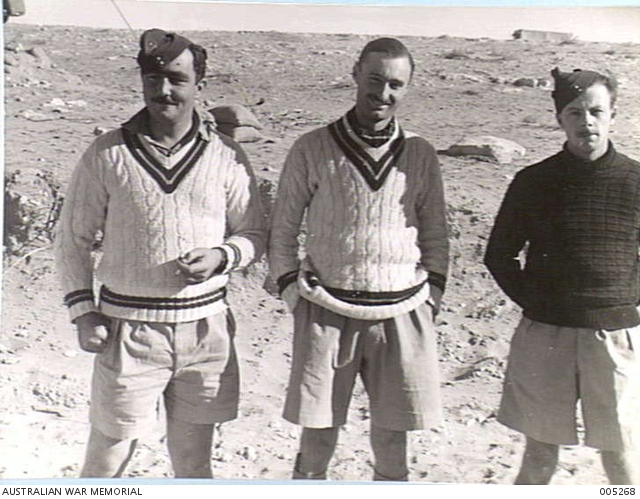
Informal group portrait of three pilots of No. 3 Squadron RAAF engaged in operations over the Western Desert in 1940.
Identified from left to right: 270526 Engineering Officer Lex D'arcy Winten of Brisbane, Queensland; O34059 Flight Lieutenant Gordon Henry Steege of North Sydney, NSW (later Air Commodore); and 272 Flying Officer Arthur Alan Gatward of Wahroonga, NSW (killed on flying operations over the Middle East on 19 February 1941).  [AWM 005268]

In December '42, Gordon returned to Australia, having completed a two-year operational tour and on promotion to WGCDR.  In January '43 he was posted to command a Fighter Sector in Brisbane.  He was also responsible for a large contingent of WAAAF ladies, including inspecting their barracks - which he refused to do.  Gordon objected, saying, "A married man should have this job." 

During a visit from the head WAAAF he told her: "If I don’t get out of this job very soon and back to a flying appointment, I am going to seduce one of your girls in the middle of that Operations Table".
-
Within a week, he was posted to the south-west Pacific to command 73 Wing! 

73 Wing consisted of three squadrons of Kittyhawks, and one each of Spitfire, Beaufighter and Boston aircraft.  Operations were conducted from Kiriwina in the Trobriand Islands and later the Admiralty Islands in March '44.  The highlight was leading a 60-strong Kittyhawk formation armed with 250lb bombs against the Japanese at Gasmata and Cape Hoskins. 


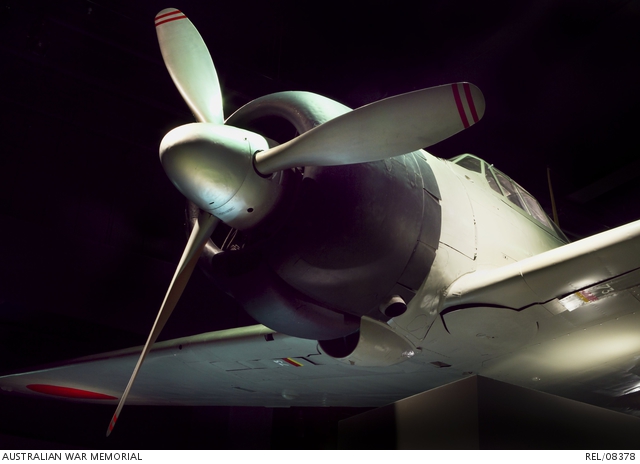
Mitsubishi A6M2 Model 21 'Zero' Fighter Aircraft in the Australian War Memorial, Canberra. 
This aircraft was abandoned at Gasmata airfield in New Britain after suffering serious damage in Allied attacks. 
In 1976 it was shipped to Australia and subsequently restored and placed on display in the AWM.

In May '44 he was promoted to Group Captain and given command of 81 Fighter Wing.  For displaying outstanding leadership and skill in leading fighter formations (namely Nos.73 and 81 Fighter Wings in the South West Pacific) and for his courage and devotion to duty, he was made a companion of the Distinguished Service Order in 1944.

Whilst returning to Australia for leave, his P40 Kittyhawk had engine failure over PNG and crash-landed on a mud bank in the Fly River.  Fortunately, his radio still worked and his Mayday calls were heard and responded-to; eventually he was rescued by a Catalina which landed on the Fly River.  He had an encounter with friendly natives and a local Patrol Officer (which may have influenced his decision to return to PNG later).  At the end of 1944 he returned to Australia to take up staff post.  In December '46 he resigned, to become a Patrol Officer in PNG. 

Air Marshal David Evans, retired Chief of the Air Staff and Berlin Airlift and Vietnam veteran, said Steege distinguished himself in WW2:

“Air Commodore Steege was not only a courageous and skilled pilot, he also excelled as a leader.  He was quick-witted and a gifted raconteur and, if he had not left the service after WW2, he may well have reached the highest level in the RAAF.”

Gordon re-joined the RAAF in June 1950 with the rank of WGCDR during the Korean emergency.  He underwent flight refresher-training and was posted to Schofields near Richmond in NSW.  In March 1951 he was posted to RAAF Williamtown for jet conversion and then to Kimpo, Korea as Commanding Officer No.77 Squadron.  There he flew the British Meteor Mk.8 jet aircraft.


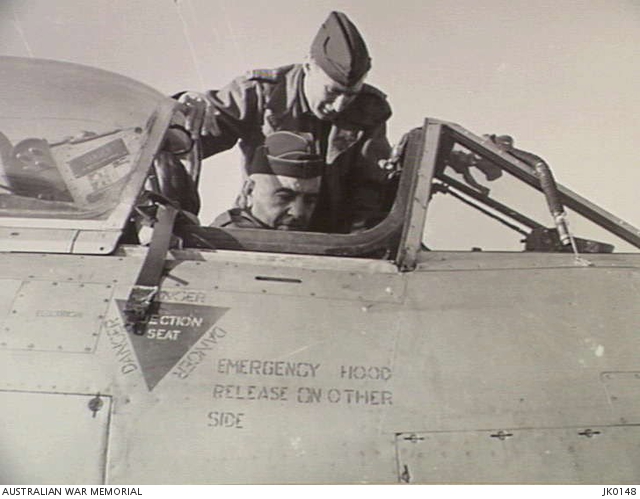
Kimpo, South Korea 1951, Air Vice-Marshal J. P. J. McCauley, Air Officer Commanding Eastern Area, RAAF, in the cockpit of a Meteor
aircraft of No. 77 Squadron, with Wing Commander G. Steege [standing], Commanding Officer No. 77 Squadron.

These aircraft were not Australia’s first preference and inferior to the opposition, the Russian MiG-15.  [In fact, the MiGs deliberately sought out the Meteors, in a political attempt to knock the RAAF out of the war.]  Better aircraft, such as the US F86 Sabre, were in short supply and unavailable to Australia...

Déjà vu for Gordon!  Yet again he was asked to fly against superior platforms: e.g. Gladiator versus Italian CR.42 and later Hurricane and Kittyhawk against Bf109 German Messerschmitts in the Western Desert.  And in the South West Pacific, Kittyhawk against the Zero threat.  Now Meteor versus the higher-performance MiG-15!  Gordon realized early the limitations of the Meteor and strongly recommended they be withdrawn from the primary role of air-to-air combat and reassigned to ground attack.  Although controversial with some, he was supported in this decision by Air Marshal Jones, the then Chief of the Air Staff.  Gordon was not comfortable with his tour in Korea; the aerial combat environment with which he was familiar had changed dramatically.  I would have to say that the RAAF erred greatly by asking too much of one of its outstanding WW2 leaders.

His remaining 20 years in the peacetime Air Force consisted of command and staff posts.  Highlights were his posting to South East Asian Treaty Organisation Headquarters in Bangkok, Thailand and Officer Commanding posts at Fairbairn ACT, Amberley QLD, Butterworth Malaysia and Edinburgh in SA.  No other officer commanded so many different RAAF bases as Gordon.  I might add that even in his later years in the Air Force, Gordon was still a skilled pilot.  Junior officers rarely praise the flying ability of senior officers, but this was certainly the case for Gordon at Edinburgh, his last command.

His last posting was Senior Air Staff Officer at Headquarters Operational Command at Glenbrook, NSW, in May 1970.  He retired from RAAF to Palm Beach in 1972 at age 55 in the rank of AIRCDRE, which he had held for eight years.   As you have already heard, he was a great raconteur; at his 'dining out' from the RAAF, he gave the best farewell speech I have ever heard (and I have heard a few).  He had a tremendous sense of humour and because of his unique careers in the RAAF and PNG, he had some wonderful stories to tell.

His consultancy career started out immediately on retirement from the RAAF.  Initially, he was with the US aeronautical company Kearfott Singer, then Martin Marietta and finally Lockheed Martin until 2005.  During these 33 consultancy years, he established some very strong friendships with his fellow US and Australian employees, mostly ex-military fliers. 

Although he contributed to many WW2 biographies, he would not write his own story.  He did agree though to participate in a RAAF oral-history program covering his WW2 experiences, which should form the basis of a substantial biography in due course.

Ladies and Gentlemen, our lives have been enriched through our association with Gordon, and his valour and determination during his WW2 service has been, and will continue to be, an inspiration to all current and future RAAF combat pilots.  I know I speak for us all and, in particular the airmen with whom he served, when I say it has been a privilege and a pleasure to have known...

...Air Commodore Gordon Henry Steege, DSO, DFC.


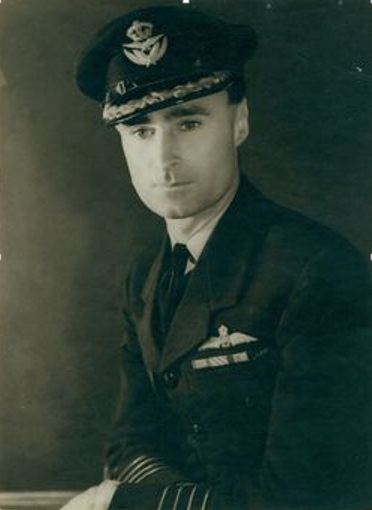
Gordon in a Group Captain's uniform.  This portrait may date from around the end of WW2.

'PNG Attitude' published the account below of Gordon's interesting times in Papua New Guinea:

The Gordon Steege Story – Flying Boats in Papua.

Air Commodore GORDON STEEGE, DSO DFC.
As told to Bill Brown

In September 1939, having graduated from Point Cook in Victoria in June 1938, I was a Flying Officer in No.3 (Army Cooperation) Squadron at Royal Australian Air Force (RAAF) Station Richmond NSW, doing my tour as Adjutant.

I was in the Officer's Mess with other colleagues when the Mess President came in.  He was a Wing Commander, perhaps in his early forties.  The RAAF was more formal in those days and we all stood for him.

It turned out the occasion was to hear Australian Prime Minister Robert Menzies “melancholy duty” announcement on the wireless that Australia was at war with Germany. 

Next morning I was told to go to Station Headquarters and report to a Flight Lieutenant Alexander, then on the staff of the station commander, Group Captain Hipolyte Ferdinand de la Rue. 

Kanga’, a World War I veteran, as a naval officer had been charge of a tug at Gallipoli dumping bodies at sea.  He then became a pilot in the Royal Naval Air Service.   He was a short fiery man who reputedly threw his telephone about his office.  Junior officers were in awe of, and avoided, him.  It was with some relief that I passed his office unsighted and reported to Jim Alexander, a pleasant man with a background of seaplane flying.

Alexander told me that, following the declaration of war; the Australian Government believed there could be already be a German raider in the Pacific, as in World War I when Von Luckner roamed the area sinking many allied ships. 

The government had acted quickly in taking from Qantas two four-engine Empire flying boats from the recently established Sydney-Singapore service, along with their flight crews and a number of maintenance men. 

These, with two RAAF Seagull amphibians and personnel, would form 11 Squadron under Alexander’s command and deploy immediately to Port Moresby to search for German raiders. 

He told me I was to be Adjutant of this Maritime Squadron.  Its operations were in a different field to 3SQN’s Army Cooperation, but I was a professionally-trained officer with experiences as Adjutant - and I was available.

He told me to clear my office at 3 Squadron immediately and go to the Qantas base at Rose Bay to meet the senior Qantas Captain (now Flight Lieutenant) Gurney and deliver some papers.  Flight Lieutenant Phil Graham would fly me down in a Seagull amphibian. 

Graham had been a short service commission officer flying seaplanes who, at the end of his term five years before, had been discharged; but with the threat of war had just been recalled into the RAAF. 

It was my first flight in a Seagull, which rattled and rumbled off the Richmond strip and continued to do so en route to Rose Bay.  I asked Graham if he'd done much flying since being called back into the RAAF.  He said this was his first flight.

Approaching Rose Bay from the north, he throttled back and started to lose height over Clifton Gardens when the engine stopped dead. 

Graham rammed the control forward and, after a very steep descent, slammed the motorless Seagull onto the choppy harbour. 

After restarting the engine, rather than take off again and alight close to Rose Bay, he taxied through the heavily southerly chop across the Harbour to the Qantas base, where he put down the wheels and lumbered up the concrete ramp to the large paved area and the hangars. 

Here I met Gurney and his former Qantas first officer, now Flying Officer Geoff Hemsworth, and the Qantas men, now RAAF airman, in the ill fitting tropical shorts with which they had hurriedly been fitted by the RAAF. There was work happening.  On each of the two Empire flying boats, bomb racks were being fitted under the wings and a hole cut in the top of the fuselage to take the machine gun.  The captain of the second Empire, Eric Simms, and his first officer were not there.

Gurney and Hemsworth had spent years flying New Guinea, were enjoying their international flying and were not exactly pleased at now being sent back to Papua. 

Later, as the Seagull rumbled back to Richmond under Phil Graham’s guidance, I decided it was not the aircraft for me!

A few days later, I was a passenger in a Carpenters Airways DH86, a biplane with fabric-covered fuselage and wings and four Gypsy Moth type engines.  Also aboard were Flying Officer Dean Smith and an Adjutant’s Clerk carrying all the RAAF manuals and publications he had hastily grabbed for setting up a headquarters.

From Sydney we flew along the east coast of Australia landing at Coffs Harbour, Archerfield, Rockhampton and arriving at Townsville late in the afternoon.  

At the old Queens Hotel on the waterfront, we met up with the crews and men of two flying boats anchored offshore.  They included Flight Lieutenant Simms, quiet and reserved, and his first officer Bill Purton, youngish with a lively sense of humour and an outgoing personality, whom I had not previously met. 

The Queens was a fine old wooden hotel patronised by planters from the Pacific islands.  I remember the waitresses’ heavily prim uniform fronts and table napkins so heavily starched they were difficult to open.

Next morning in the DH86 we landed at Cairns and then Cooktown, where we were taken by truck into the sleepy frontier town for lunch at a hotel.  Back to the aircraft and across the Coral Sea to land at Port Moresby strip at the east end of Ela Beach, so short the DH86 used every inch of it.

We, and the men on the Qantas flying boats, which had arrived earlier, were accommodated in tents with the Heavy Battery which was completing the installation on Paga Hill of 9.2 inch coast guns for the defence of Port Moresby.


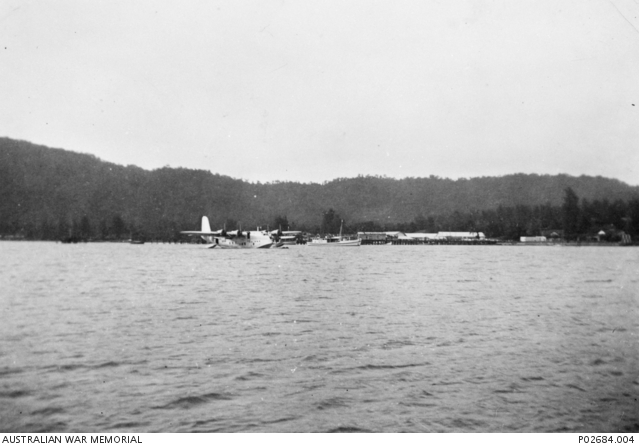
c1941.  An RAAF Short Empire flying boat (A18-13) moored in Port Moresby harbour.  The ridge line in the background is known as Paga Hill.  This aircraft, formerly known as 'Coolangatta', was part of the QANTAS Empire Flying Boat fleet until it was impressed into service with the RAAF, joining No.41 Squadron, RAAF, on 28 August 1940.  The aircraft was transferred to No 11 Squadron, RAAF, on 8 November 1941 working out of Darwin, Ambon and the Netherlands East Indies.  On 29 July 1943 the aircraft was returned to QANTAS to resume normal passenger services.  On 11 October 1944 this aircraft crashed at Rose Bay, Sydney, killing one passenger and injuring 15 others.  [AWM P02684.004]

11 Squadron HQ (Squadron Leader ‘Alex’ Alexander, the Clerk and I as Adjutant) were set up in Mr Geoff Clay’s trochus store with its pungent odours.  The airmen were lodged in a house on the hill to the east of and looking down on the town and the Officers Mess, set up in the house of a Dr Strong (an absentee anthropologist) on Ela Beach. 

Alexander and Simms had houses on Paga Hill, as their wives had also arrived.  The officers in the mess were Flight Lieutenant Gurney, Flying Officers Hemsworth, Purton, Hampshire and Anderson, RAAF navigators for the two boats, Dean and Swift, and myself.

Nights could be noisy.  One night in a room off the bar in the old top pub, Purton, Hemsworth, Hampshire and I were in good voice with Mr Clay, always immaculate in whites, who, a World War I digger was teaching us to sing Do You Remember Yvonne and her Estaminet on the Hill.

Some miners from Bulldog were also in good voice.  The publican, unable to control the scene, kept switching off the lights and he eventually left them off, to the resentment of the miners. 

As our party left in the darkness, down the steps, we were stopped by a tall dark figure, at the same time as a miner called out, “You treat a man like a bloody dog!” 

The tall dark figure was the town policeman.  He thought we had made the comment to him, and he advised, “This conduct is not becoming for you Air Force officers.  Now go home - and quietly.

Next day, in my office with Purton and Hampshire, none of us appreciating the ever-present trochus odour, the publican came in to see the CO.  Purton and Hampshire immediately shot through. 

The CO called me in and said, “I understand you and some others were creating undue noise in the hotel last night.

I replied that we were just singing some World War I songs with Mr Clay.

Whereupon Squadron Leader Alexander said, “From my house, I could hear, ‘Oh please don’t burn our shithouse down, Mother has promised to pay,’ and I could hear your voice leading it.”

Our thoughts were of the war in Europe.  Strangely we were not conscious of the Japanese threat of invasion. 

We knew Commander Eric Feldt in Moresby was using the Empire flying boats to visit government officers and planters at outlying posts and plantations to set up the Coastwatcher organisation, but this was more related to a threat from German raiders.  Purton wrote the following memorable ditty:

We come from over there,
Not over it here, where C’est la guerre,
And although we’ve volunteered to go
We will never see the foe
And when it’s Peace Day
What will we say
Stick your Peace Day
We are the bludgers from Papua
And we never saw the war.

As Adjutant, it was my duty to encrypt and decrypt the secret messages which flowed between 11 Squadron and Defence in Australia.  For example, instructions for the flying boats on patrol in areas north and east of New Britain and New Ireland. 

The code used was known as the ‘one-time pad’.  It involved two books, the larger the size of an exercise book containing pages of five-figure numbers; the smaller, a virtual dictionary of words and phrases, each with a number. 

A message via Moresby radio would open with the number of pages in the large book, then a line number, then the number of five-figure groups on that line.  From this the next number in the message would be subtracted and the result referred to the small dictionary where it would be given a word or phrase.

This was a laborious process which, after dinner at night, I would return to the office to undertake, occupying some hours.  Walking home along Ela Beach sometimes around midnight I would pass a figure in the dark and invariably get “Good night Taubada.” No fear walking in the middle of the night -  Moresby was a law-abiding place in those days!

As Adjutant of 3 Squadron I had regular flying and in 11 Squadron I missed this.  Alex was a sympathetic, and said, “I’ll teach you to fly the Seagull and you can get some flying in that.”

He knew I had a background of sailing so had experience of picking wind direction on the water, coming up to a buoy and so on.  So we got into the cockpit of the Seagull, he took the left-hand seat and controls, did a circuit of Port Moresby, then changed me into that seat for a take-off and alighting.

I managed a reasonable take-off, but coming into approach I was 'Hawker Demon' - a steep gliding turn - and the thing went down like a brick to level out as I put it on the water in what I thought was a reasonable manoeuvre. 

As we taxied to the buoy, a white-faced Alex said, “Gordon, don't do that again!”  Then he got out of the aircraft and sent me off alone for a couple of circuits.

New to the Seagull flying boats, I first took a couple of local flights around the Port Moresby area.

These included the hairy experience of flying Commander Hunt, who headed a small naval surveying detachment, delivering some mail to Yule Island at low level over offshore reefs in a strong south-easterly, when the Seagull appeared to be going as fast sideways as forward.

Then my CO, ‘Alex’ Alexander, asked if I would like to take the Seagull down to Samarai. 

I jumped at this, and with a Sergeant Navigator, Wireless Operator and Engineer Fitter we had an enjoyable straight and level flight on a beautiful day, perhaps three hours at 90 knots, along the coast to Samarai. 

I moored the Seagull at anchor off the east shore, and, leaving an anchor watch aboard, three of us were taken ashore and accommodated in Mrs Skelly's attractive old Queensland-type hotel, one of three on the island.

In those days, Samarai was strikingly beautiful and romantic, rightly deserving the description ‘Pearl of the Pacific’.  There were no engine-driven vehicles on the island, and crotons, hibiscus and coleus lined the attractive paths.

Dressed in my best tropical uniform, according to the order given to me by Alex, I called on Mr Aumuller, manager of Burns Philp, in his attractive house on the highest point of the island, and then went on to the Resident Magistrate, who was away, so I met the ARM.

Syd Elliott Smith was an impressive head of government on the island, a lively, strong and likable personality.  He kindly had me to dinner at his house that night with his wife and a Mrs Champion whose husband was away on the mainland.  I suspect this was Claude Champion, one of the brothers who were so notable in Papua New Guinea.  I learned years later that Claude had lost an eye while based on Samarai. 

I was reluctant to leave this beautiful island, but next morning we weighed anchor in a strong breeze and short high chop, taking off to the north-west just off shore with many watchers for there had been only one previous visit by a Seagull - from one of our pre-war cruisers. 


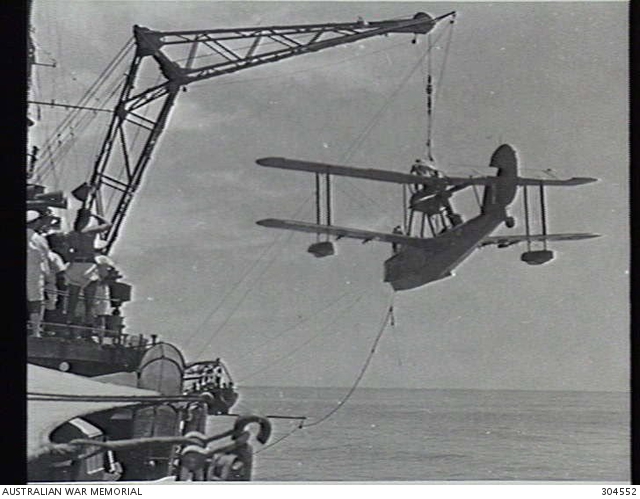
C.1940.  A LIGHT CRUISER OF THE RAN HOISTS INBOARD ITS VICKERS SUPERMARINE SEAGULL RECONNAISSANCE AND OBSERVATION AMPHIBIAN AIRCRAFT.  (AWM 304552.  NAVAL HISTORICAL COLLECTION.)

Somehow that beast of an aircraft ran from the wind and we careered along the line of chop with the port wing float dragging low and dangerously in the water.  So I had to backtrack and start again in front of the Samarai audience.

But the morning was not over.  An hour en route to Moresby, one of the crew reported strong stomach pains, and the other two were also in difficulty, as I then found I was myself. 

With no alternative, I chose to alight on the open sea about a kilometre offshore.  When holding off just above the water, I saw flashes of light below the surface.  It was a reef which could rip the bottom from the Seagull.  Not a desirable outcome on that lonely coast.  So I powered on until I was sure I was over blue water.

There were apertures in the Seagull: at the bow, a lidded hatch; more on each side of the glass-enclosed cockpit; aft of the high mounted pusher engine; and also a lidded hatch in the top of the hull to take a machine gun.  Immediately four white backsides pointed out over the side to groans of relief.

The take-off into the offshore swell was, as usual, a little hairy.  Then half an hour later I saw coming in from the northwest, and right across our track, the nastiest and blackest guba (northwest line of storm) I had seen. 

The Seagull’s instruments were limited to turn, bank, climb and descend and I knew I could not fly it, or for that matter any aircraft, through that maelstrom. 

The Sergeant Navigator pointed out Abau government station on the map, so I decided to seek shelter there.  I asked the Wireless Operator whether he had been able to advise Moresby and he said, “I was trying to do that when you took the trailing aerial off on the trees, pal.

With thought of coral which might lie unseen just under the muddy waters in Cloudy Bay, we alighted well offshore and taxied to anchor in the river on south-east side of the tiny island of Abau. 

A heavy whaleboat with a white man in the stern and two Papuans came out and came against the hull without discernible damage.  I explained the situation to Mr Lambden, the Resident Magistrate, and he said if we had landed half an hour later we would have hit submerged rocks. 

Leaving the Seagull at anchor, he took us ashore.  I noted he was concerned when I told him of our toilet stop – he hoped we had not brought dysentery with us.  But he put us up for the night as the guba passed. 

In Moresby, I met Alison, the teenage daughter of Mr Lambden, home on school holidays, who later married David Marsh, Patrol Officer and District Commissioner, who became a lifelong friend.  At Abau I saw the lonely marble gravestone of a Mr Flint, Resident Magistrate who had died there some years earlier.

On 27 February 1940 Sir Hubert Murray, Lieutenant Governor of Papua, died in Samarai, while touring the South-East in the Government Yacht Laurabada.  He had been in Papua since 1908 and was highly respected by Papuans and expatriates.

One of the 11 Squadron Empire flying boats was sent to Samarai to bring the casket to Moresby for the funeral.  At the jetty where the casket was to come ashore there was to be a large contingent of the Royal Papuan Constabulary and the Heavy Battery, all with fixed bayonets and half a dozen Navy Surveyors.

The airmen I had available for the Air Force guard were mainly ex-Qantas men who had had no rifle drill, so I paraded the RAAF guard with side arms.  They turned out well but even so one of them managed to surreptitiously slip on a camera and strap.

The big Empire boat flown by Gurney and Hemsworth came in from the southeast low over Ela Beach and just above the Top Pub to alight close in.  


The flag draped casket was brought to the jetty by the RAAF launch and came ashore directly in front of the RAAF guard then passed the fully armed Navy party and Heavy Battery to what appeared to be a couple of hundred armed Royal Papuan Constabulary and the entire population of expatriate residents of Moresby. 

The cortege was followed by thousands of Papuans and set off along the road around the harbour foreshore to Konedobu, Murray's last resting place.  It was a beautifully organised and most impressive ceremony.

“But who is like him in Papua?” asked a Hanuabadan at the great masai ariana, or death feast, which was attended by thousands of Papuans.

In May 1940, Alex informed me that men from business and commerce were being brought in as Administrative Officers to be appointed to posts as Adjutants, and pilots such as myself would return to full-time flying appointments. 

With my ex-civilian replacement on the way, Alex asked whether I would like to remain with 11 Squadron, and I said; “And fly what?

He said; “Seagulls.

No thanks,” I said.  “I understand 3 Squadron is to go overseas.  I would like to return there.” Which I did.


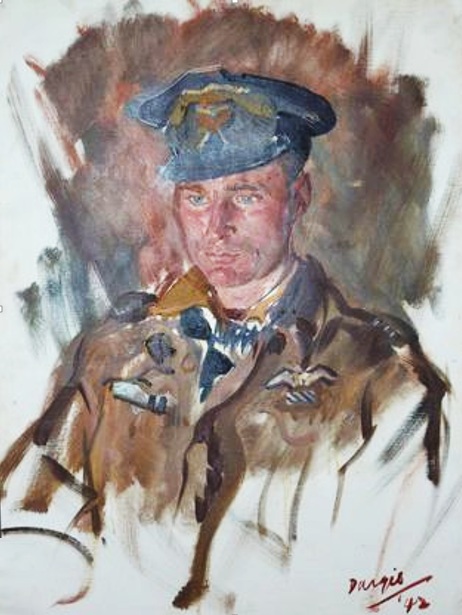
A portrait of Gordon in the Desert, by Sir William DARGIE.

***

After two and a half years in the Middle East, including command of 450 Fighter Squadron and attending the Middle East Staff School at Haifa, I returned to Australia at the end of 1942.

By now Wing Commander, I was appointed to command the newly formed 73 Wing and move its two fighter squadrons (Spitfires and P-40s), a Beaufighter and a Boston squadron to a forward base to be developed on Kiriwina in the Trobriands.  This was to be a forward fighter base to refuel US P-38 fighters, to enable them to escort eventual B-24 strikes on Rabaul.

I had learned that soon after the Japanese occupied Rabaul, the Americans sent a single B-25 day bomber on a mission to bomb the large base there.  Gurney, then commanding a Catalina Squadron in Moresby, volunteered to go in the B-25, as the Americans did not know the area and Gurney knew it well. 

They were attacked by Zeros over Rabaul, were badly hit and were limping home damaged when they were forced to make a crash-landing at Kiriwina.

Later, when the strip on Kiriwina was under construction, I took a P-40 there from Goodenough and saw nose and main wheel drag furrows leading to Gurney’s B-25, which had rolled onto its back.  Gurney, in the nose, died there.  I think the Americans also did not survive.  [The crucial Gurney Strip in Milne Bay was named after him.]

And what happened to my other comrades?

Purton, flying an Empire boat with a full load of refugees from Java to Broome, was shot down by Zeros.

Hemsworth was Captain of a Catalina which found the Japanese naval force heading for the Coral Sea engagement, and being instructed to shadow and report, was soon shot down by Zeros.

John Anderson, in a Hudson converted to a bomber, did not to return to Darwin from a strike against Japanese shipping in the Celebes.

Beaumont and his Seagull went down with the Australian cruiser HMAS Perth in the Battle of the Sunda Strait.

So much for the “Bludgers of Papua!

Of the nine aircrew in the original 11 Squadron, only Flight Lieutenant Eric Sims (ex Qantas Captain), Flying Officer John Hampshire (RAAF Navigator) and Flying Officer Gordon Steege (Adjutant) survived the war.

After the war, I became Director of Operations at RAAF HQ in Melbourne and then made what to some might be a surprising career change, arriving in PNG as a Patrol Officer in January 1947. 

My first posting was to Esa’ala and I then spent six months at the Australian School of Pacific Administration before being posted to Kairuku in January 1948.

In late 1948 I was transferred to Madang, where the District Officer was J K McCarthy and the ADO Tom Aichison.

By early 1949 I was off to Bogia, where the ADO was Lloyd Hurrell.  With respect to Lloyd, who I have always held in high regard, I do not and have never had flat feet!  If I ever said I had, as he insists, it was a bullshit comment! 

In mid-1949 I was promoted to Manus as ADO under DO’s Ken Bridge and then Tom Aitchison.

In August 1950, after a last patrol to the Western Islands, my wife ill, I resigned from the Territory service to return to the RAAF as Wing Commander.


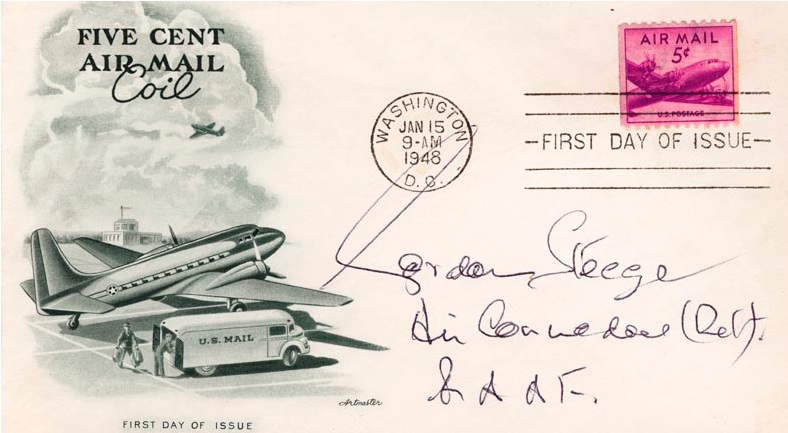
Gordon signed this airmail 'first day cover' some time after 1970, although the card itself dates from 1948, at which time Gordon was on patrol in the PNG islands.

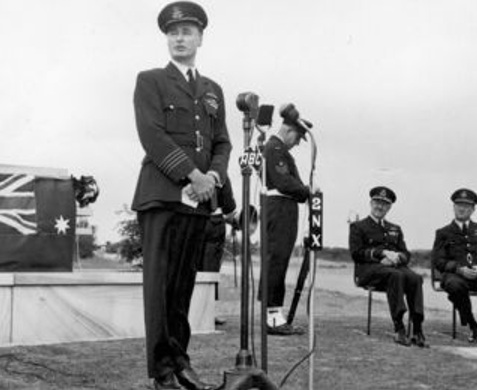
Gordon wearing Group Captain's uniform and giving a speech over the radio, at the dedication of the 450 Squadron Memorial at Williamtown in 1961.

3 Squadron LIFETIMES

3 Squadron RAAF HOME / Search